Ferrari 308 GTS QVEuro-spec · 1984 · Chassis 47339 benchmarkwww.308gts.me
Sales comparables from Bring a Trailer, RM Sotheby's, and Bonhams since January 2020. Every data point below links to the auction house listing it came from. Refreshes monthly on the 1st.
The Car
Exterior
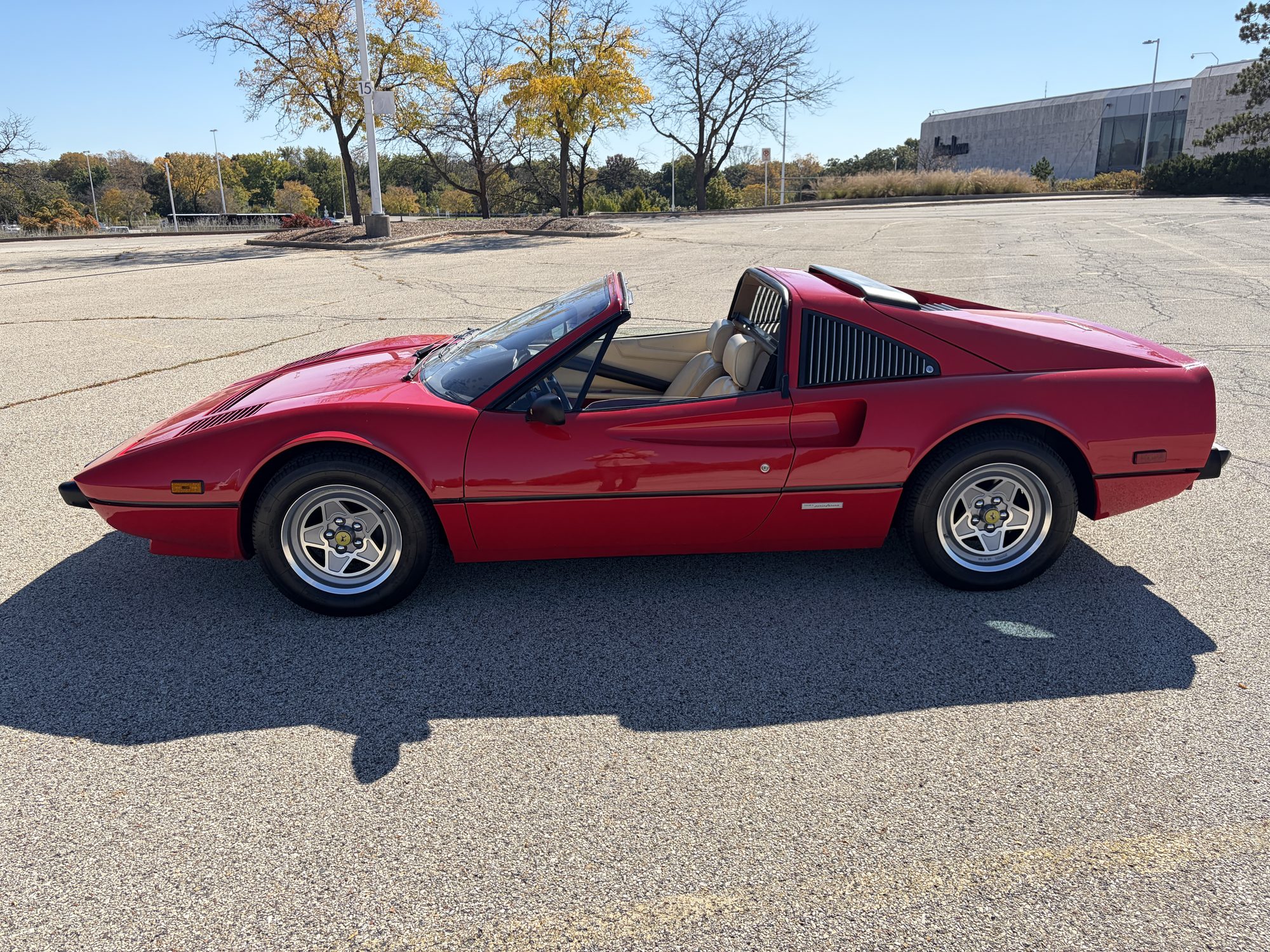 Side profile · driver
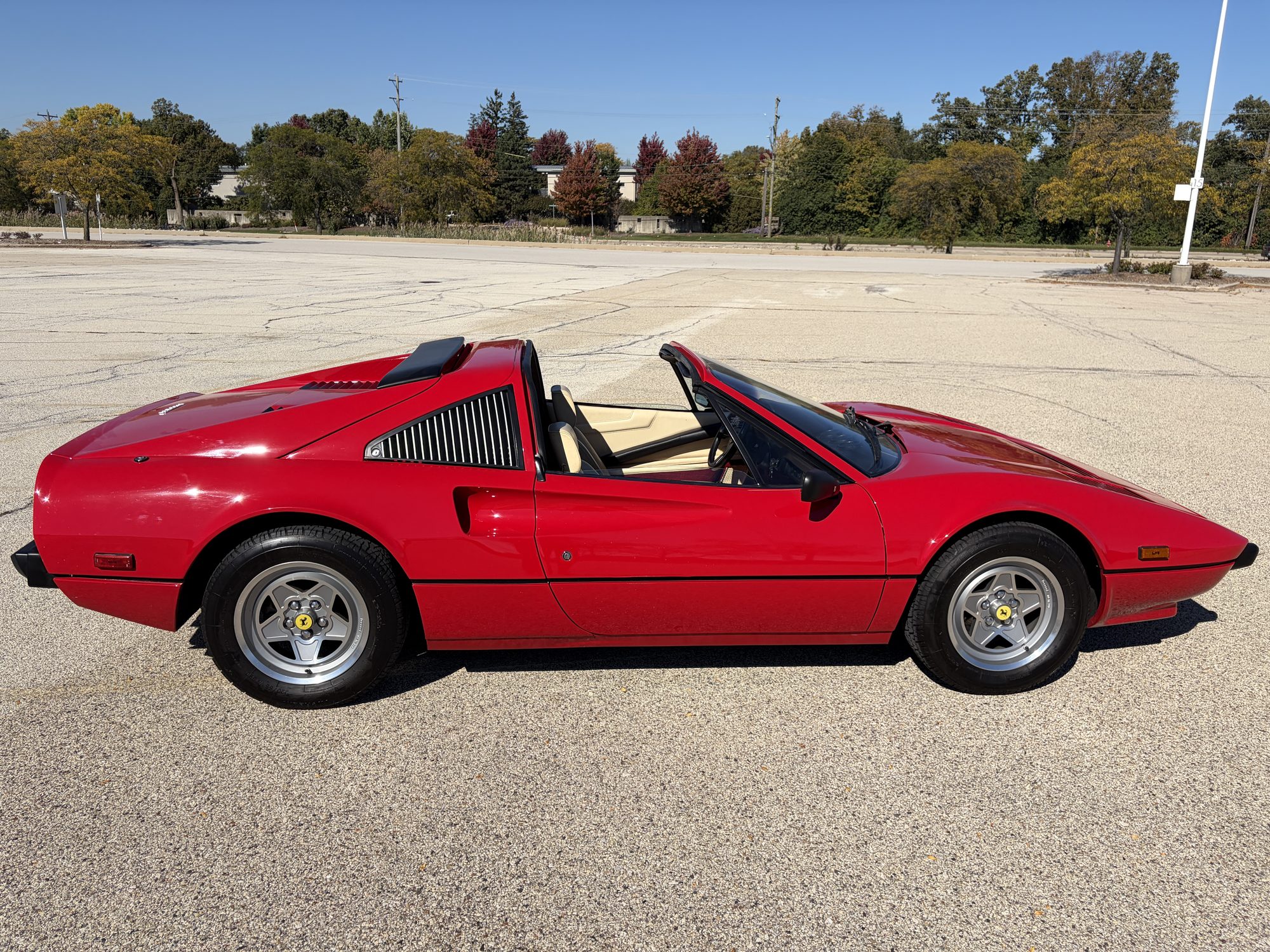 Side profile · passenger
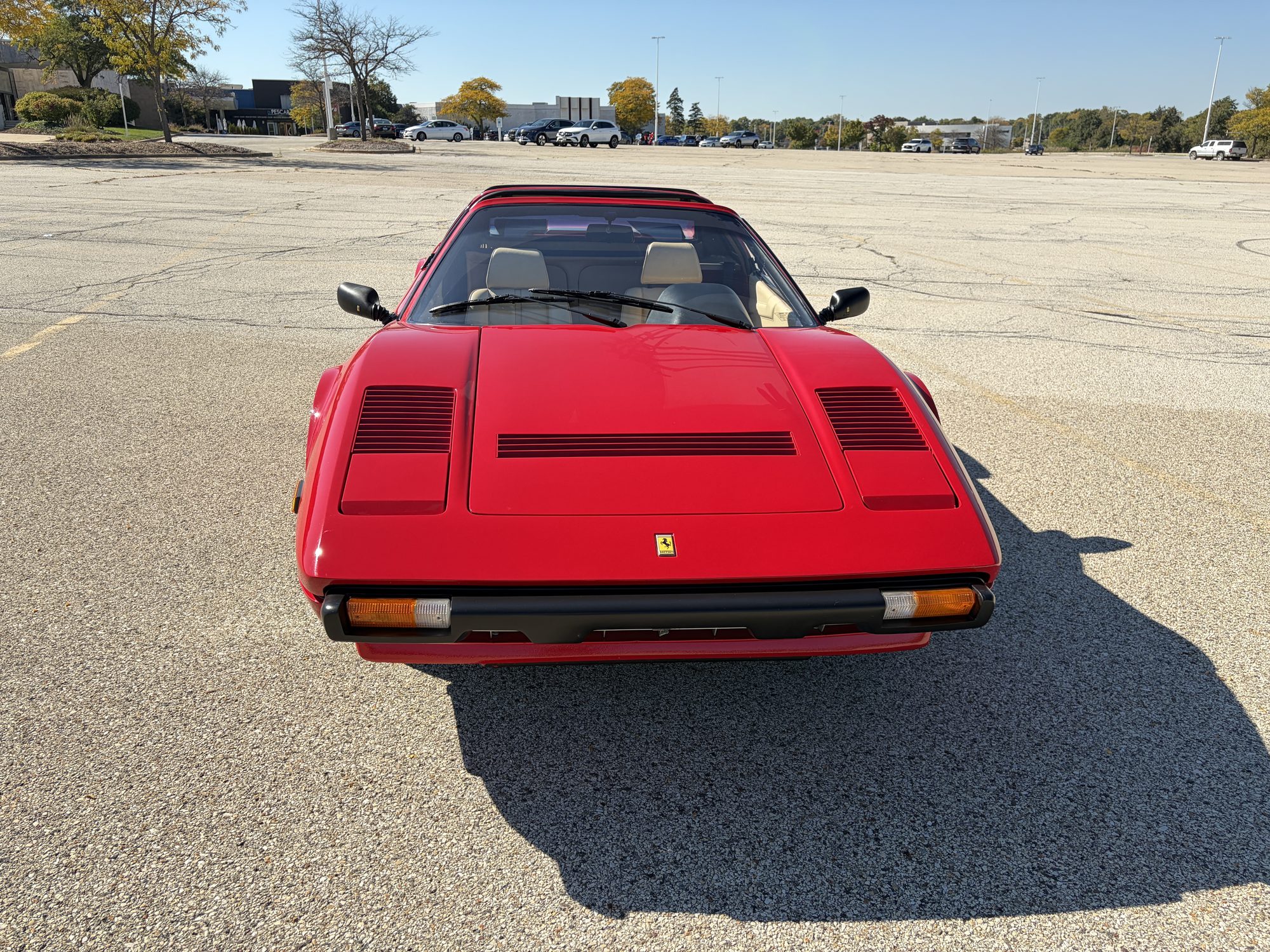 Front · elevated
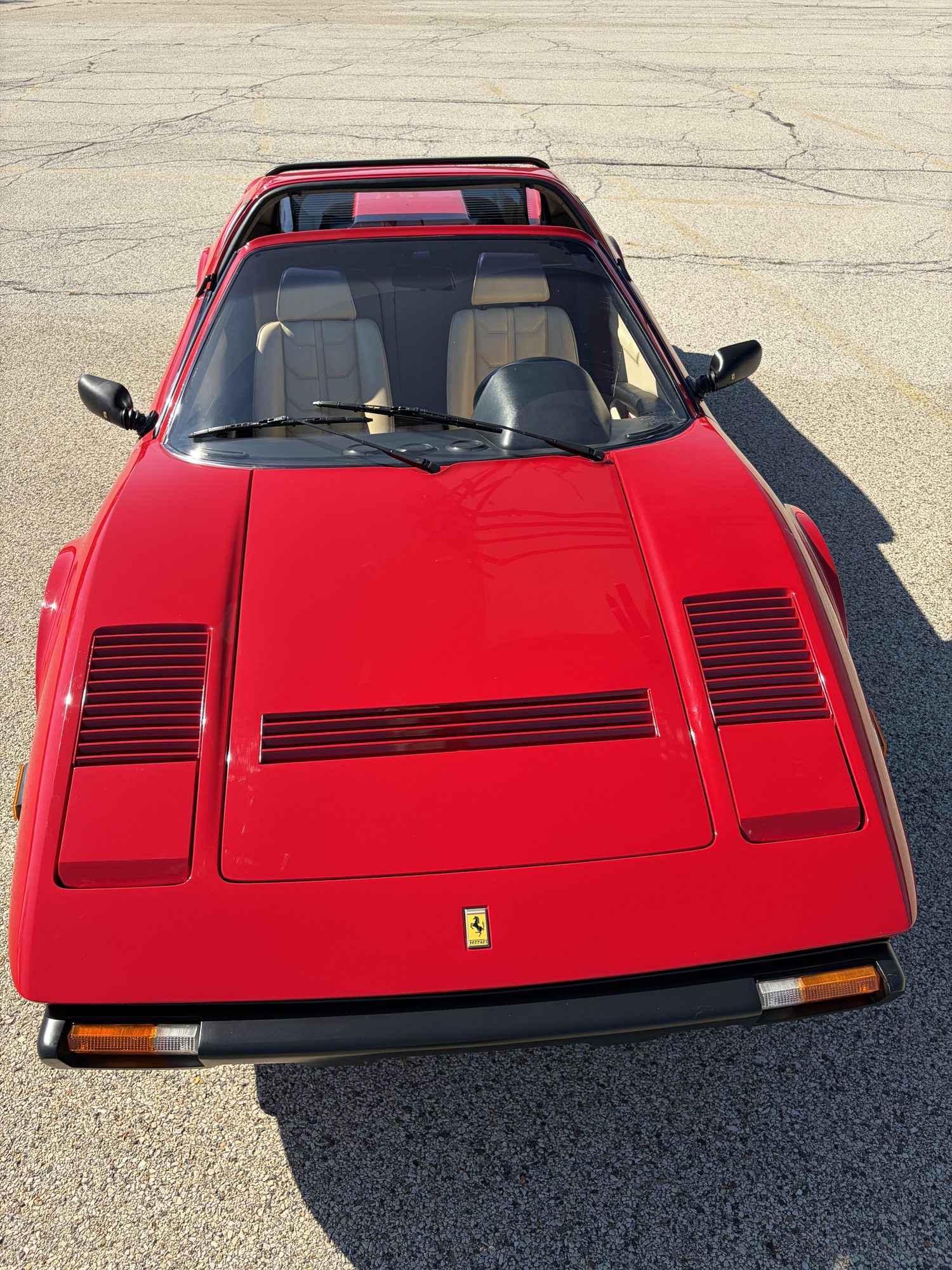 Front · hood and louvers
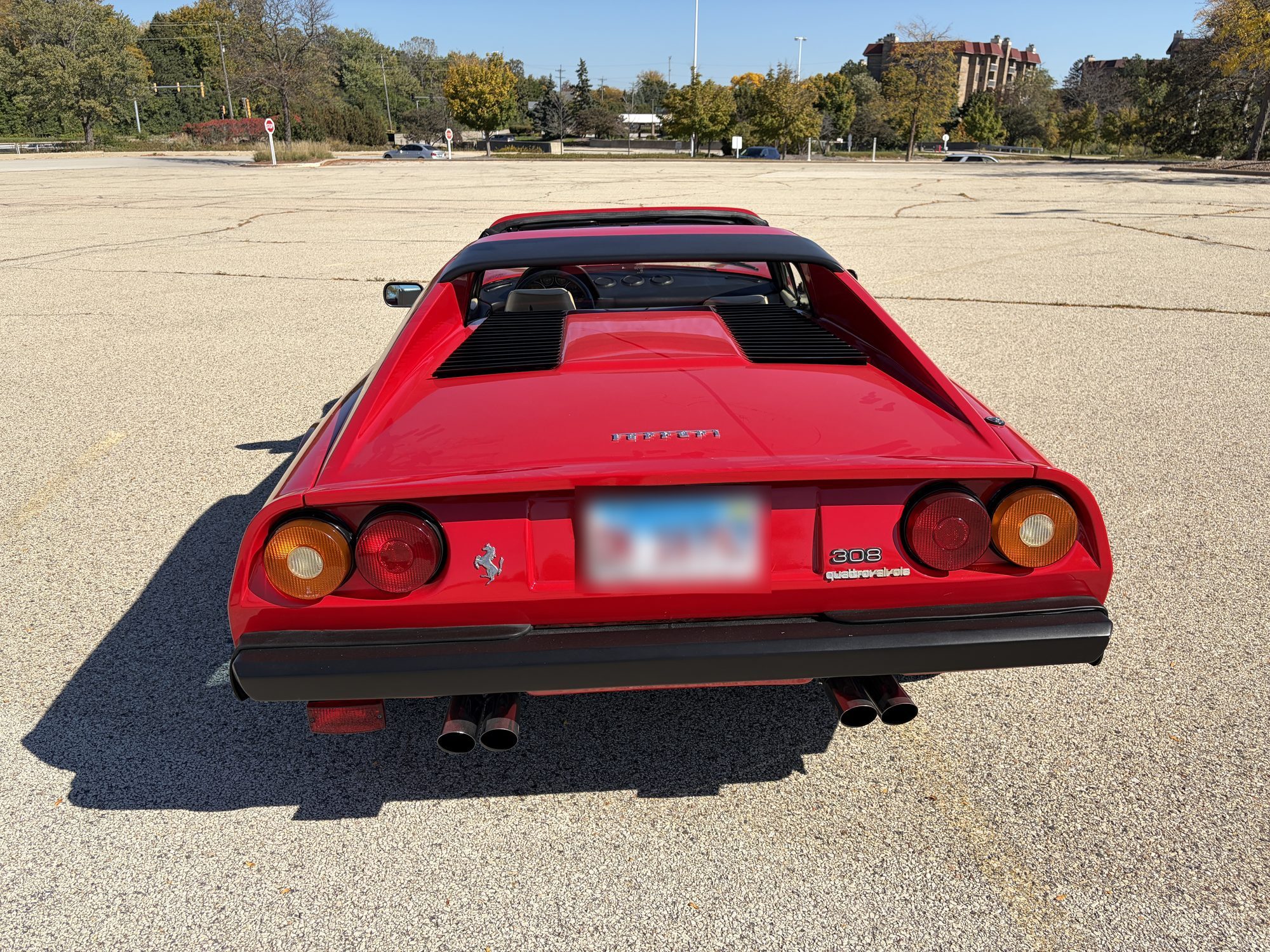 Rear · dead-on
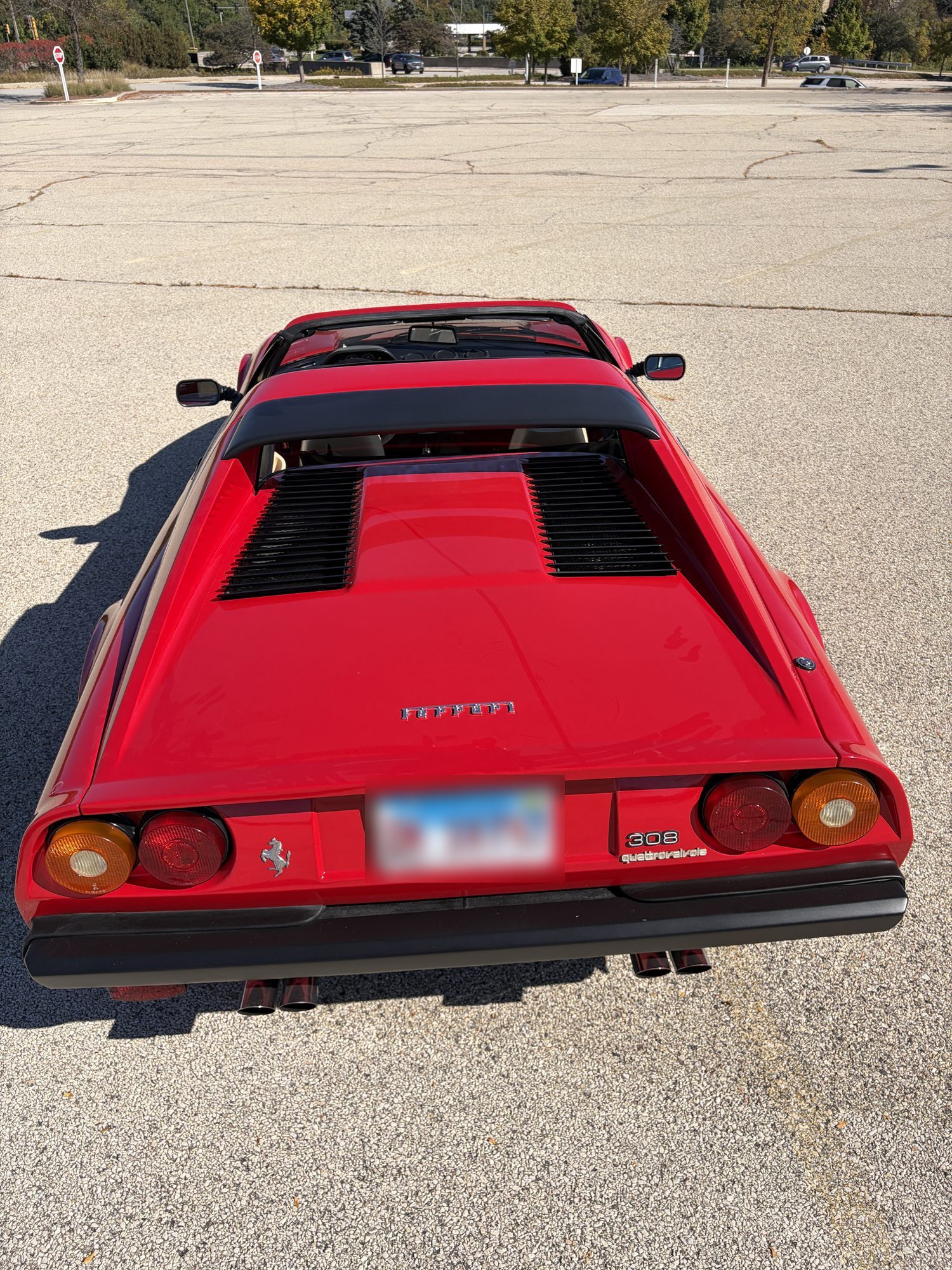 Rear · elevated
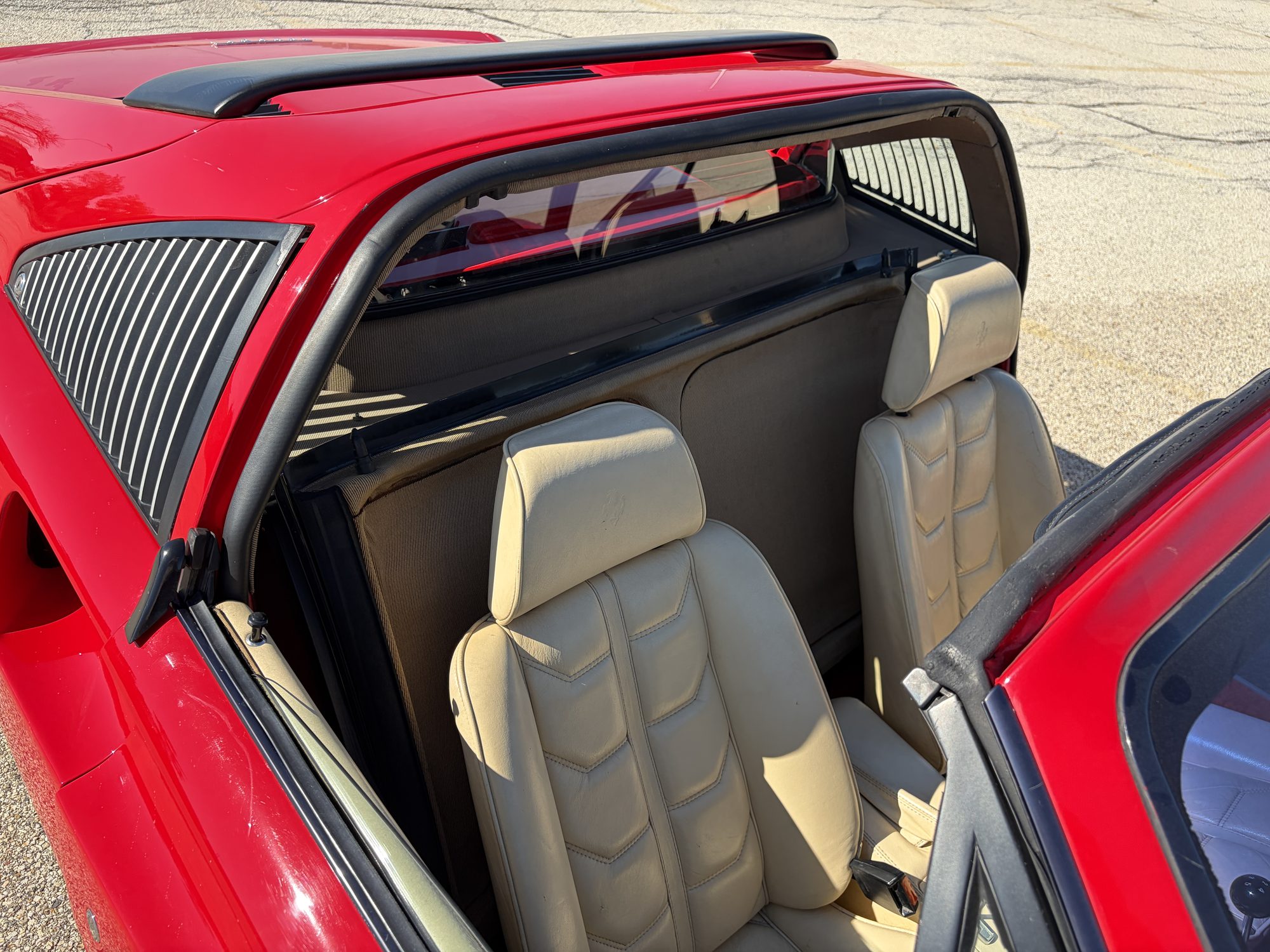 Rear quarter · targa off
Documentation · windshield VIN sticker, chassis plate, paint label, odometer
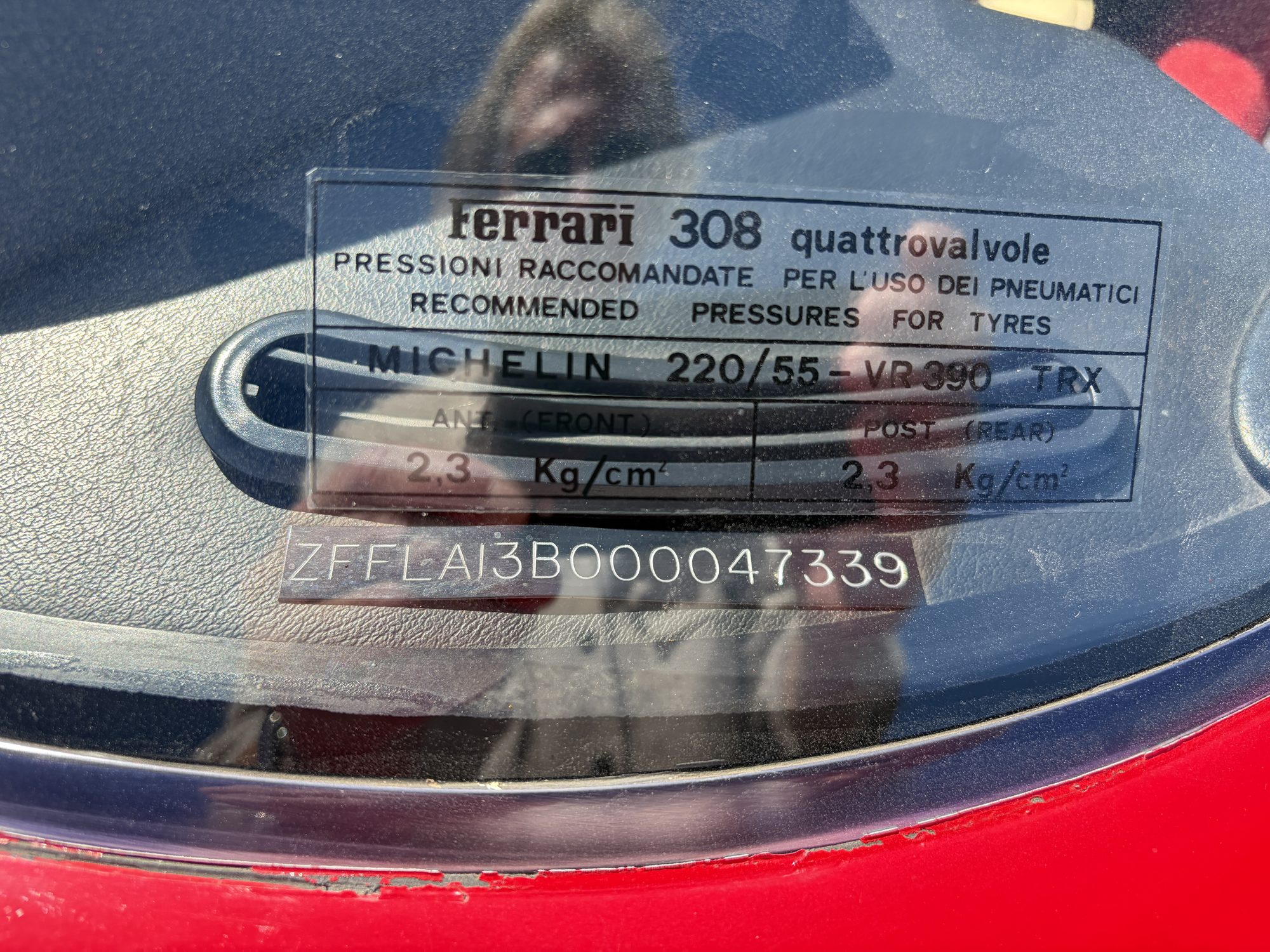 Windshield VIN sticker · ZFFLA13B000047339
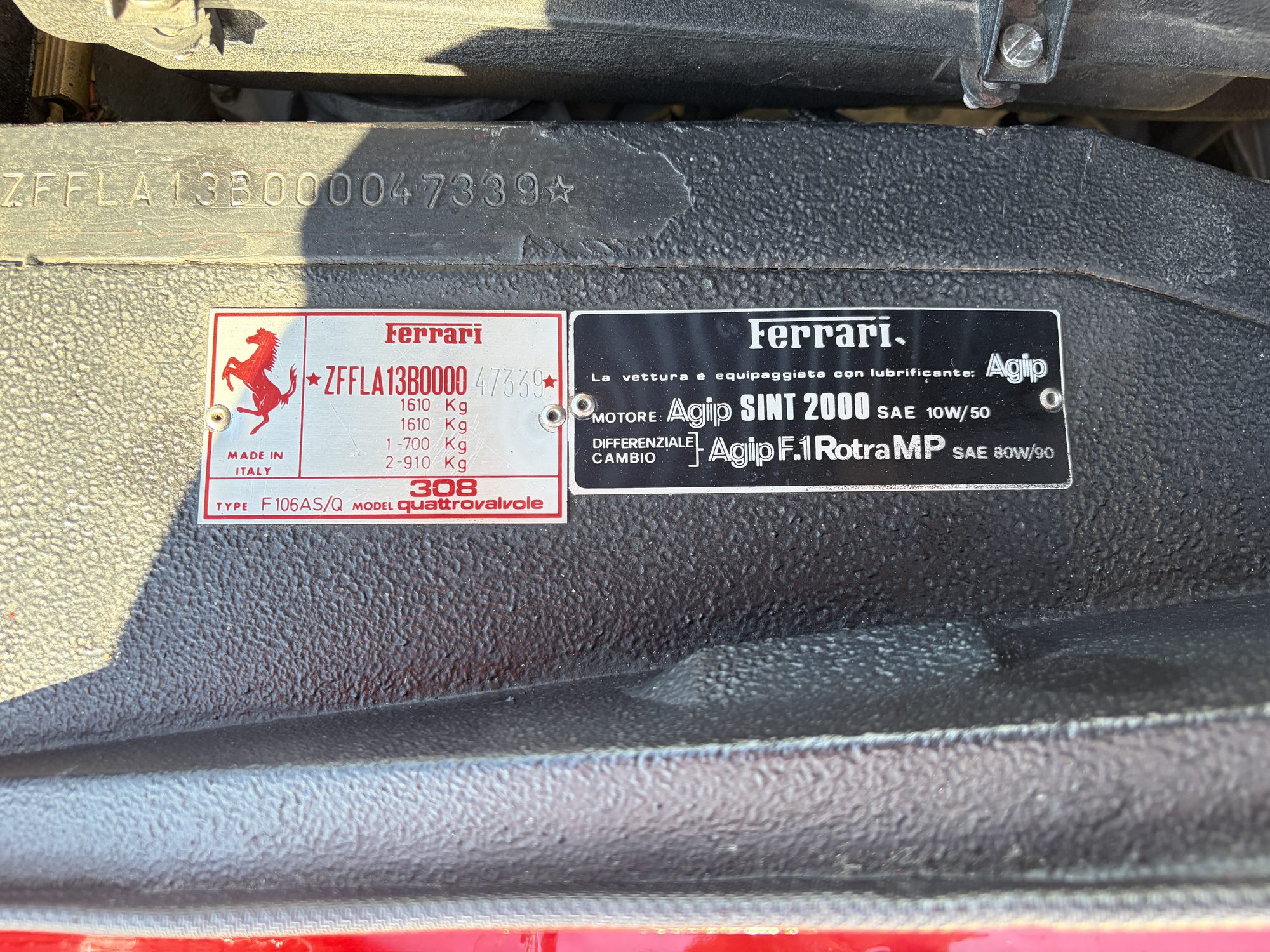 Chassis plate · stamped chassis number
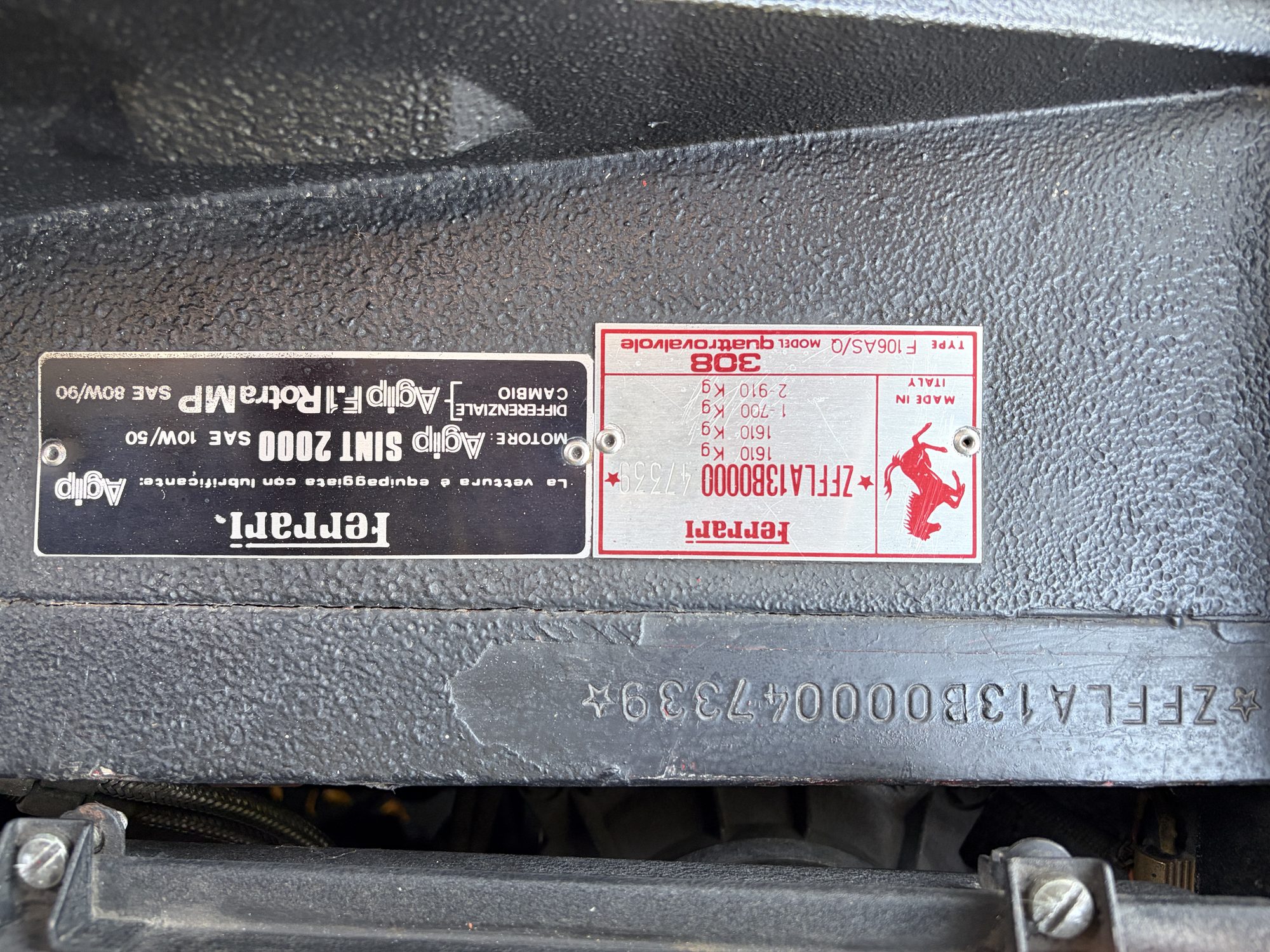 Chassis plate · wide view
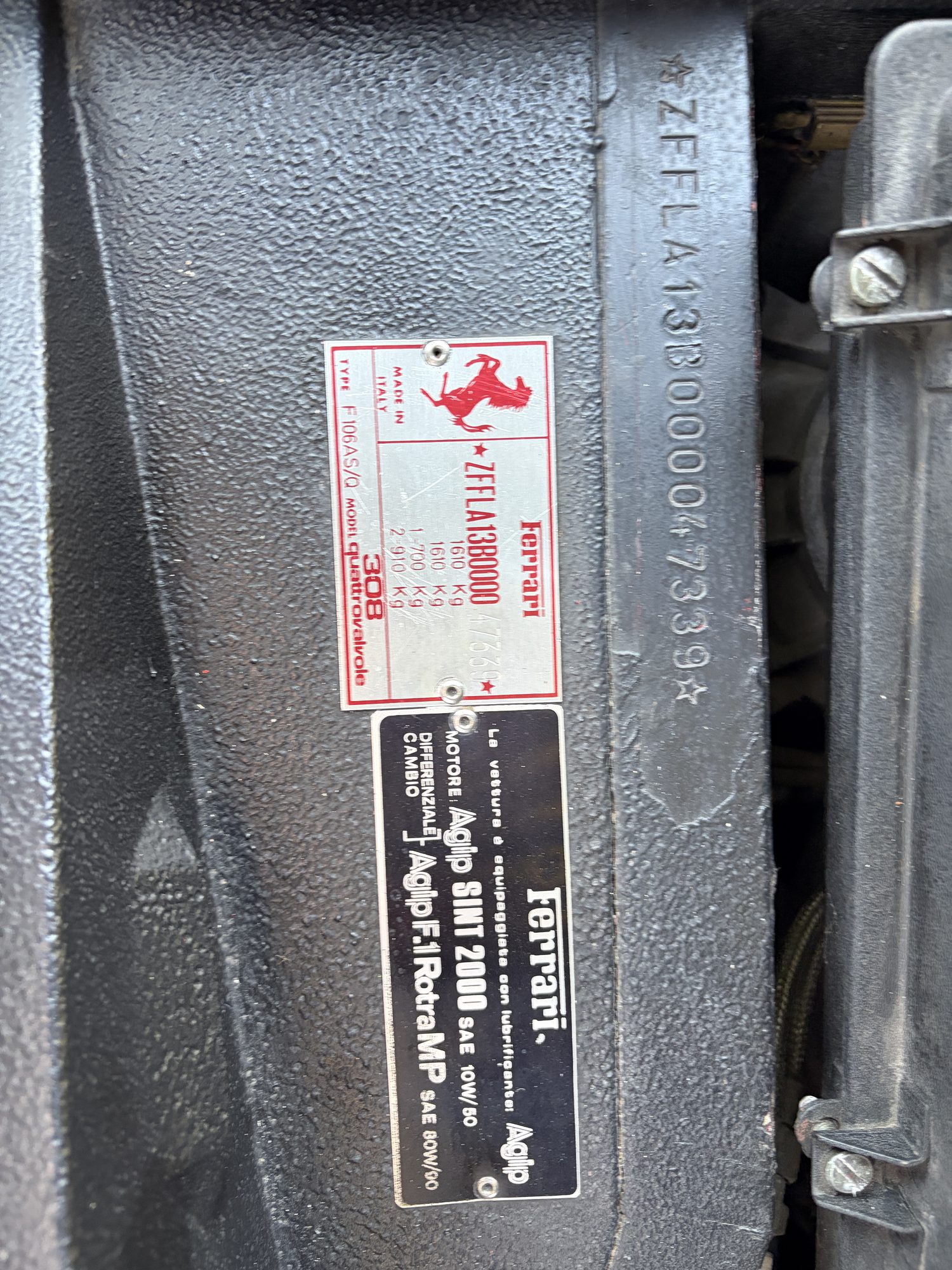 Chassis plate · vertical view
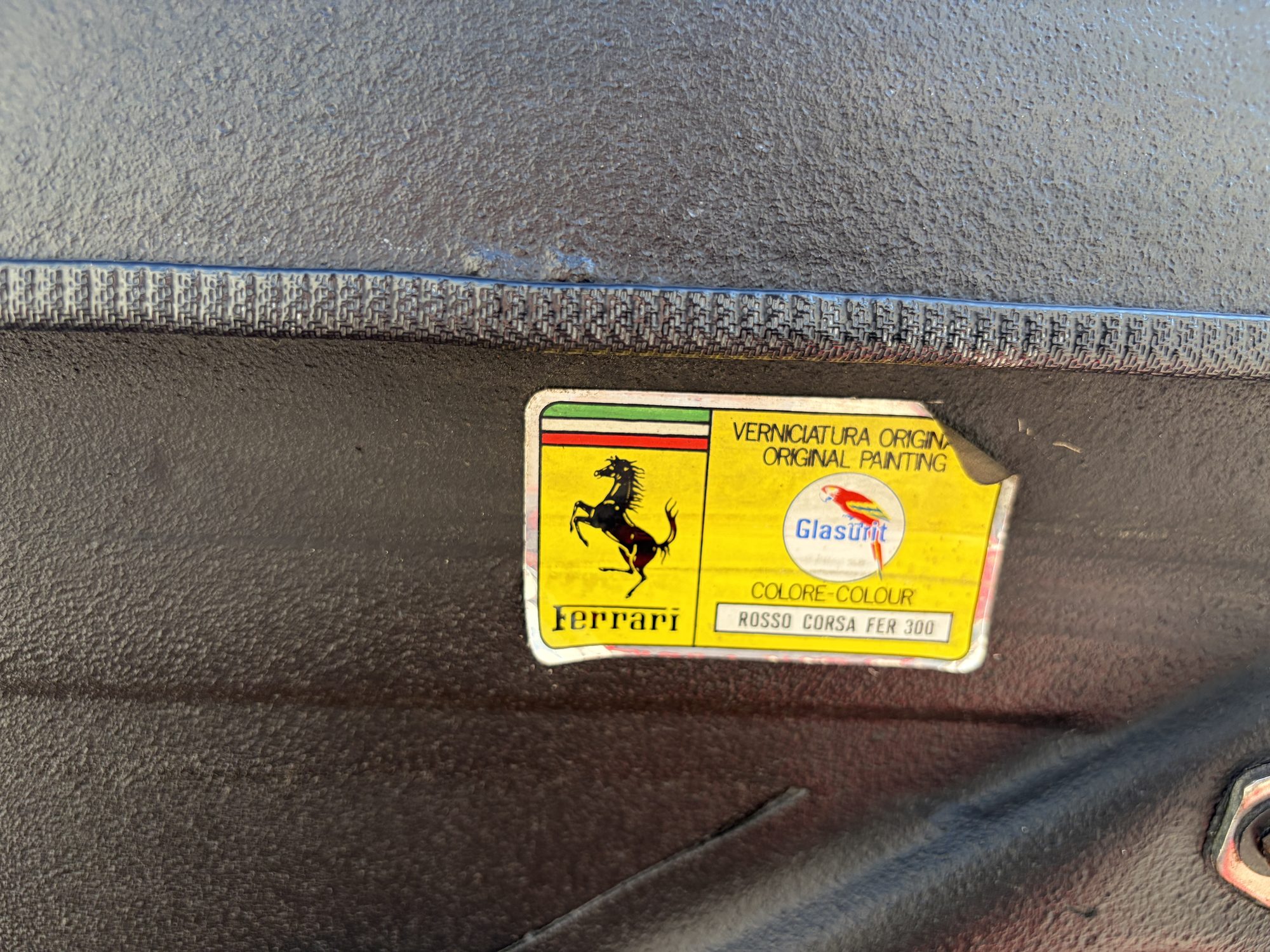 Paint label · Rosso Corsa FER 300
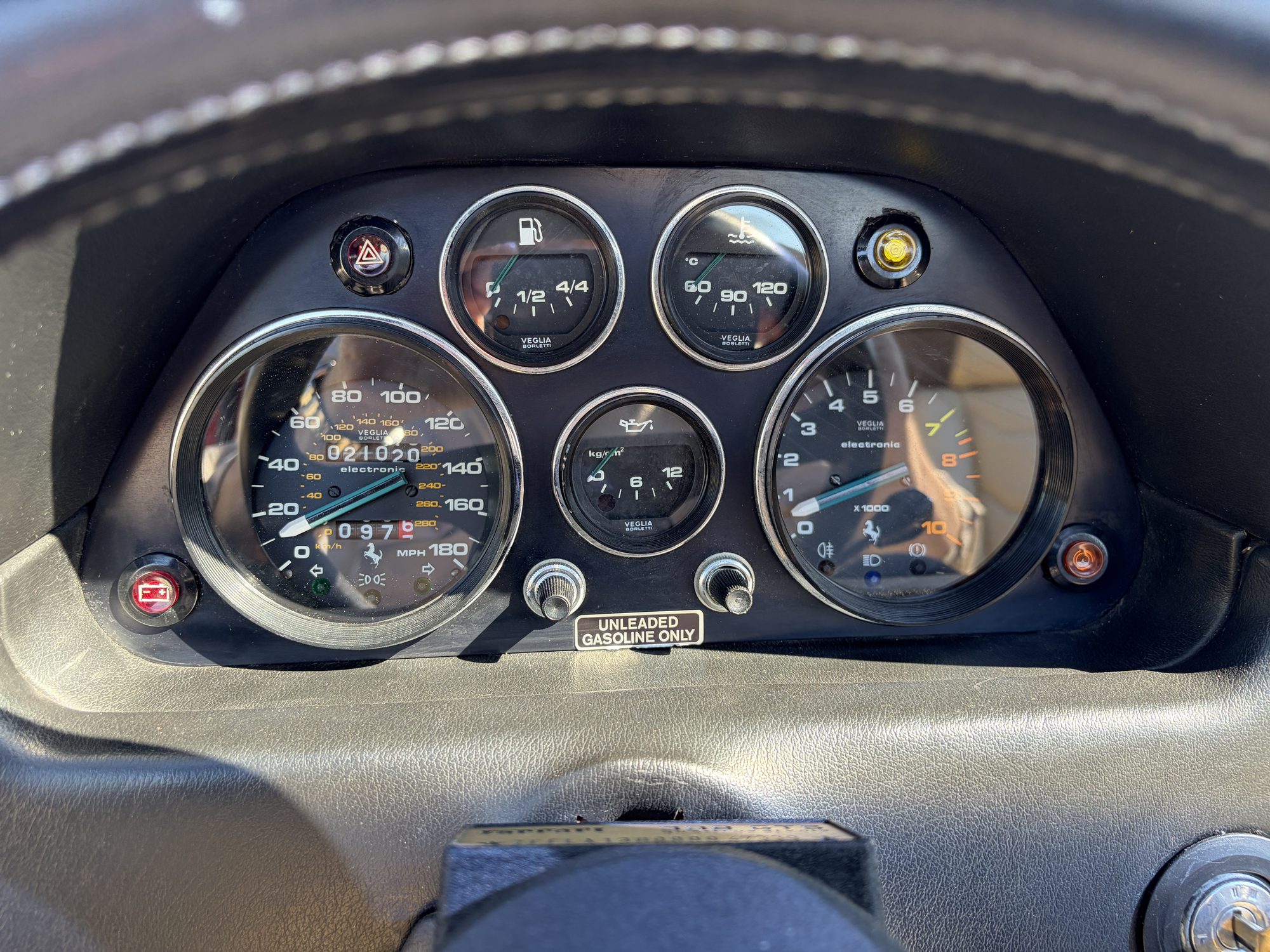 Odometer · 21,020 mi
Window sticker · reproduction for display only
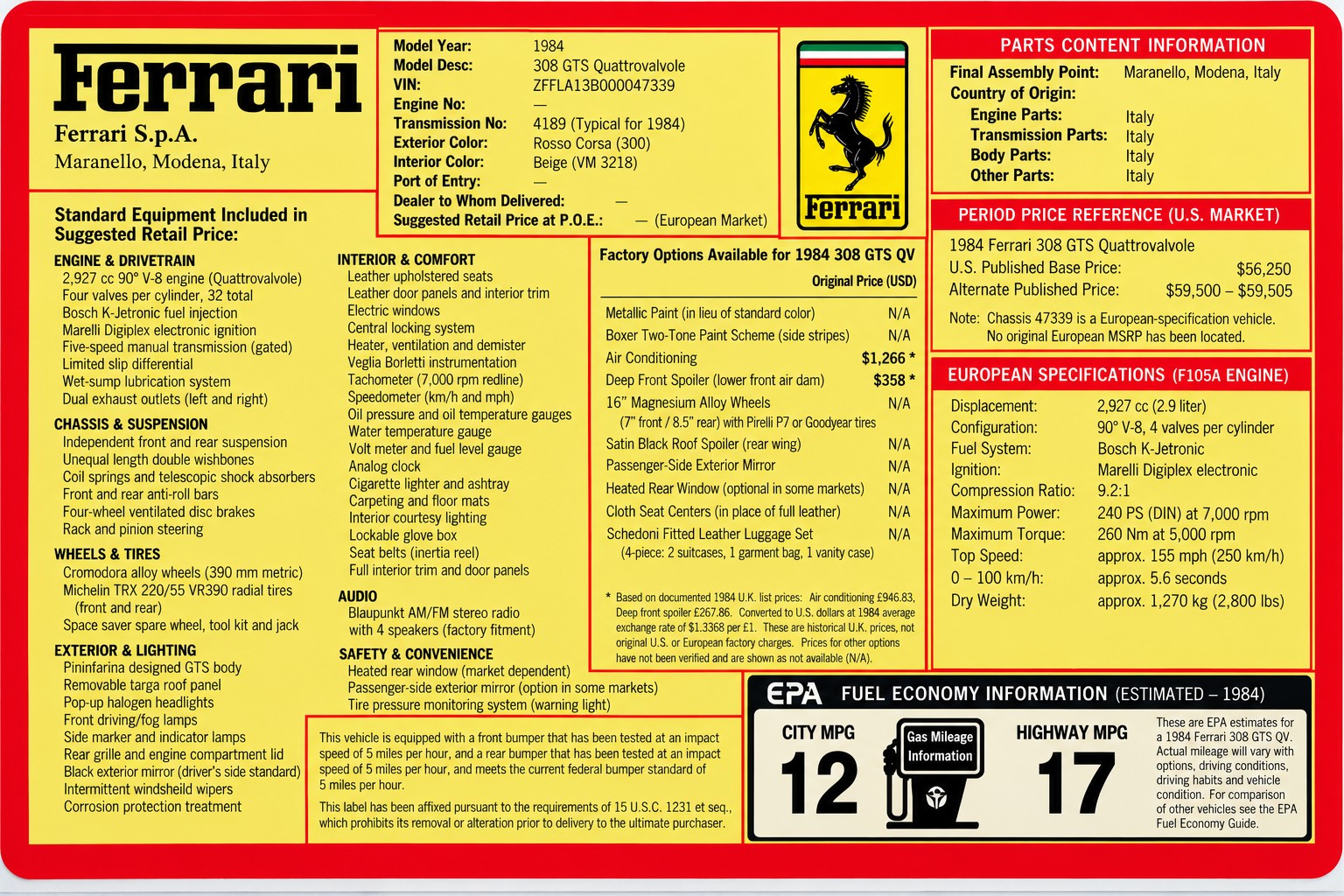 Reproduction window sticker · display only, not a factory document
Interior · Crema hide + deep-red carpet
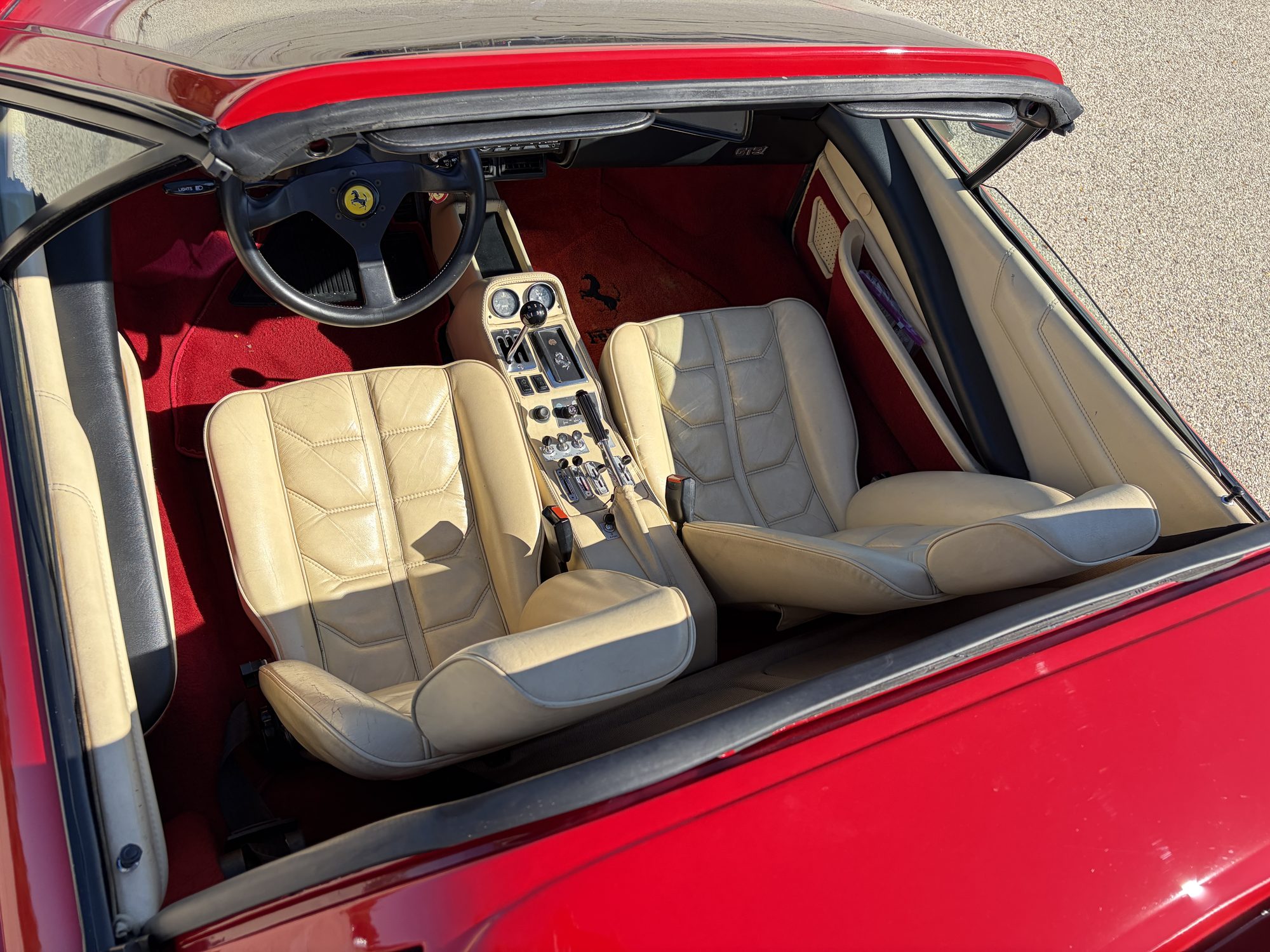 Cabin · overhead
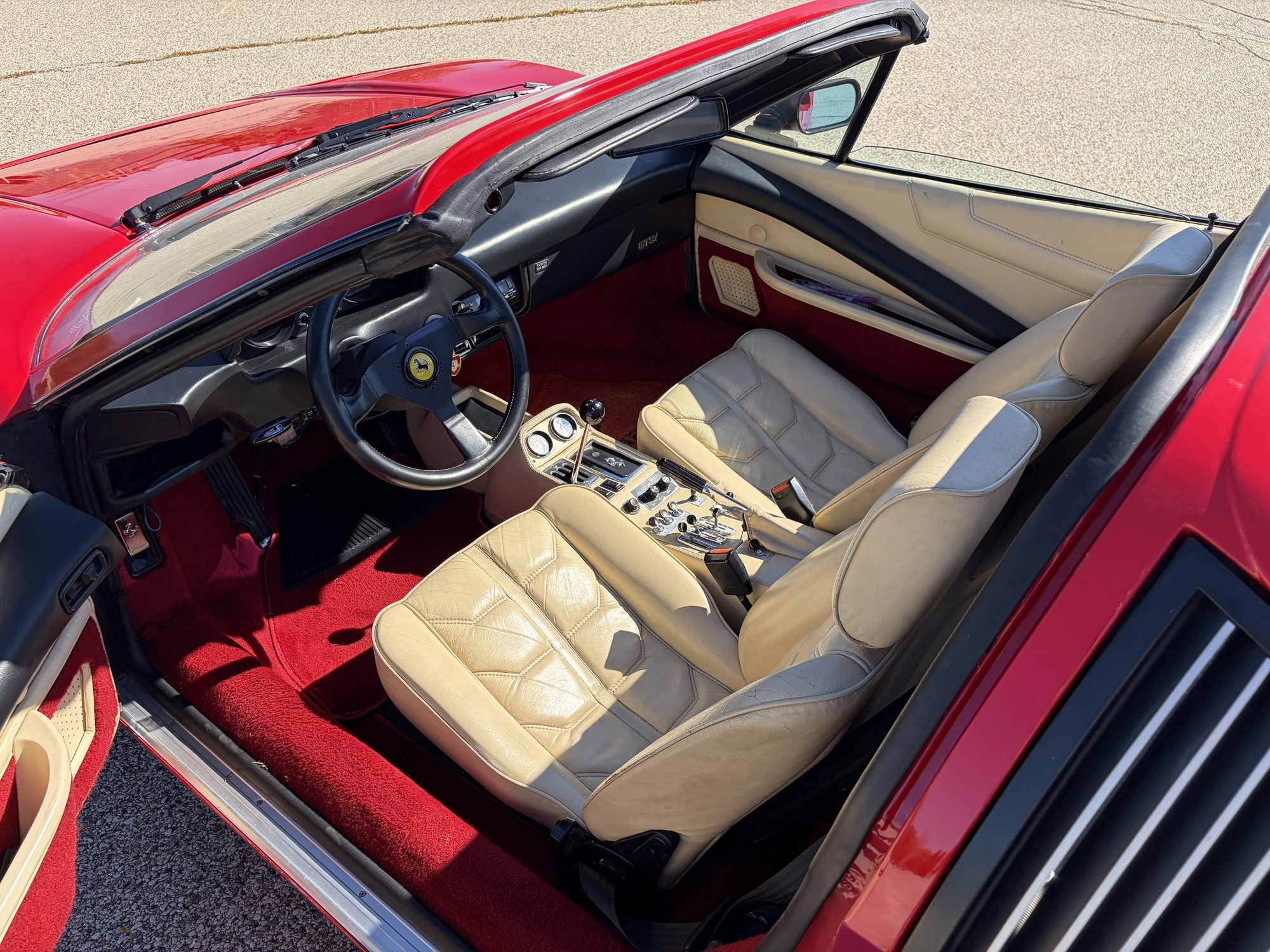 Cockpit · passenger side
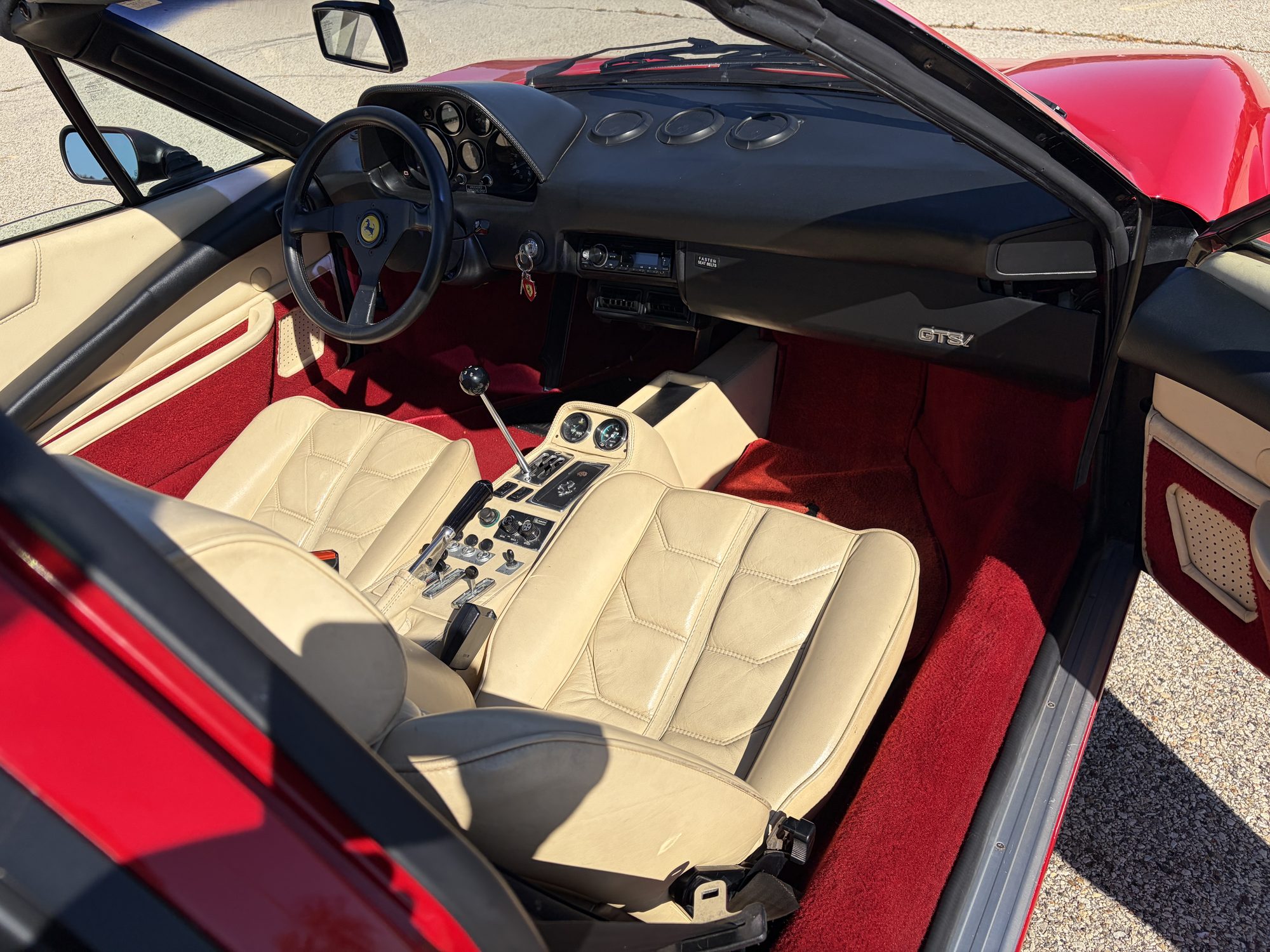 Dash · GTSi glovebox badge
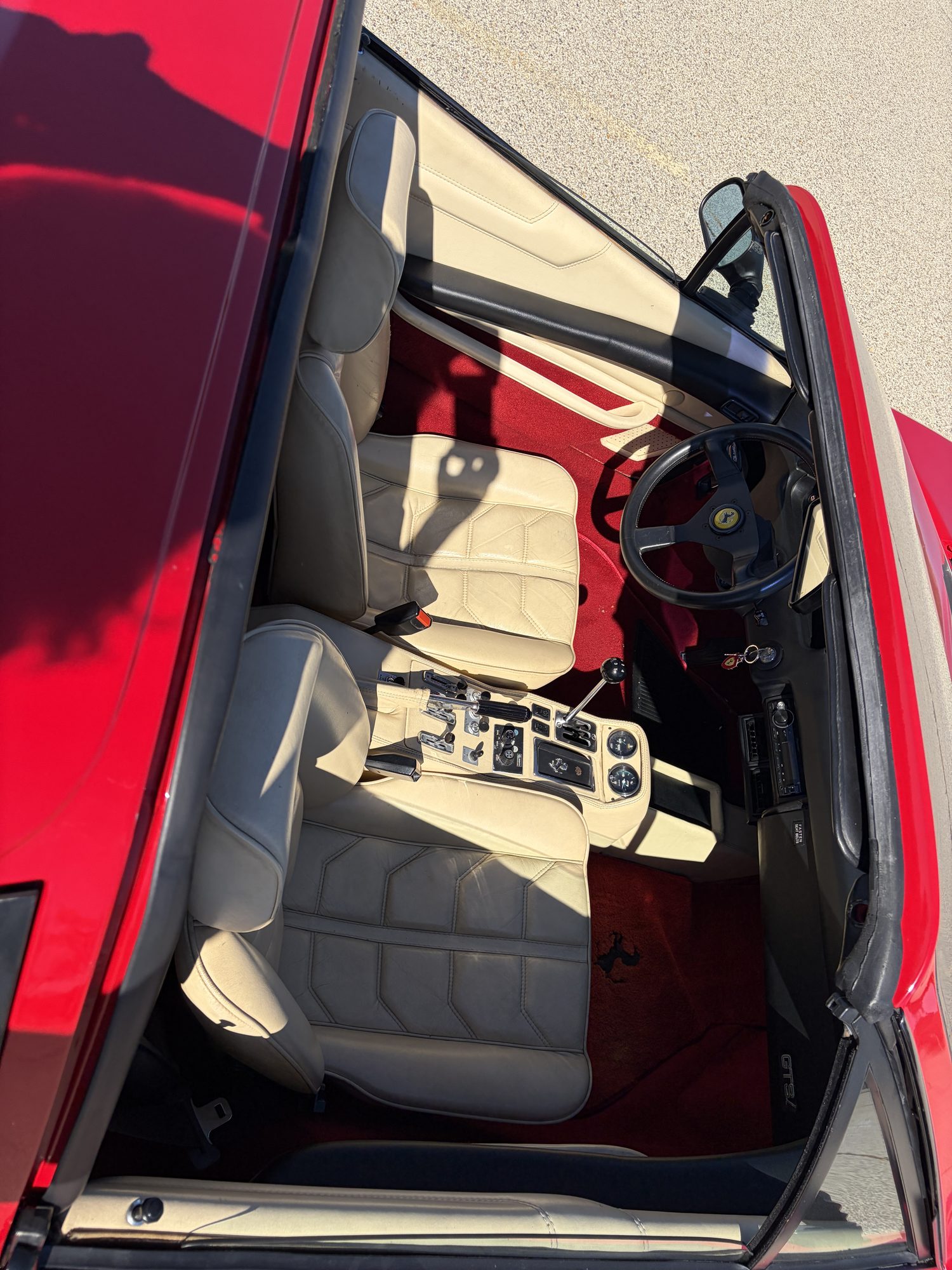 Cabin · driver door open
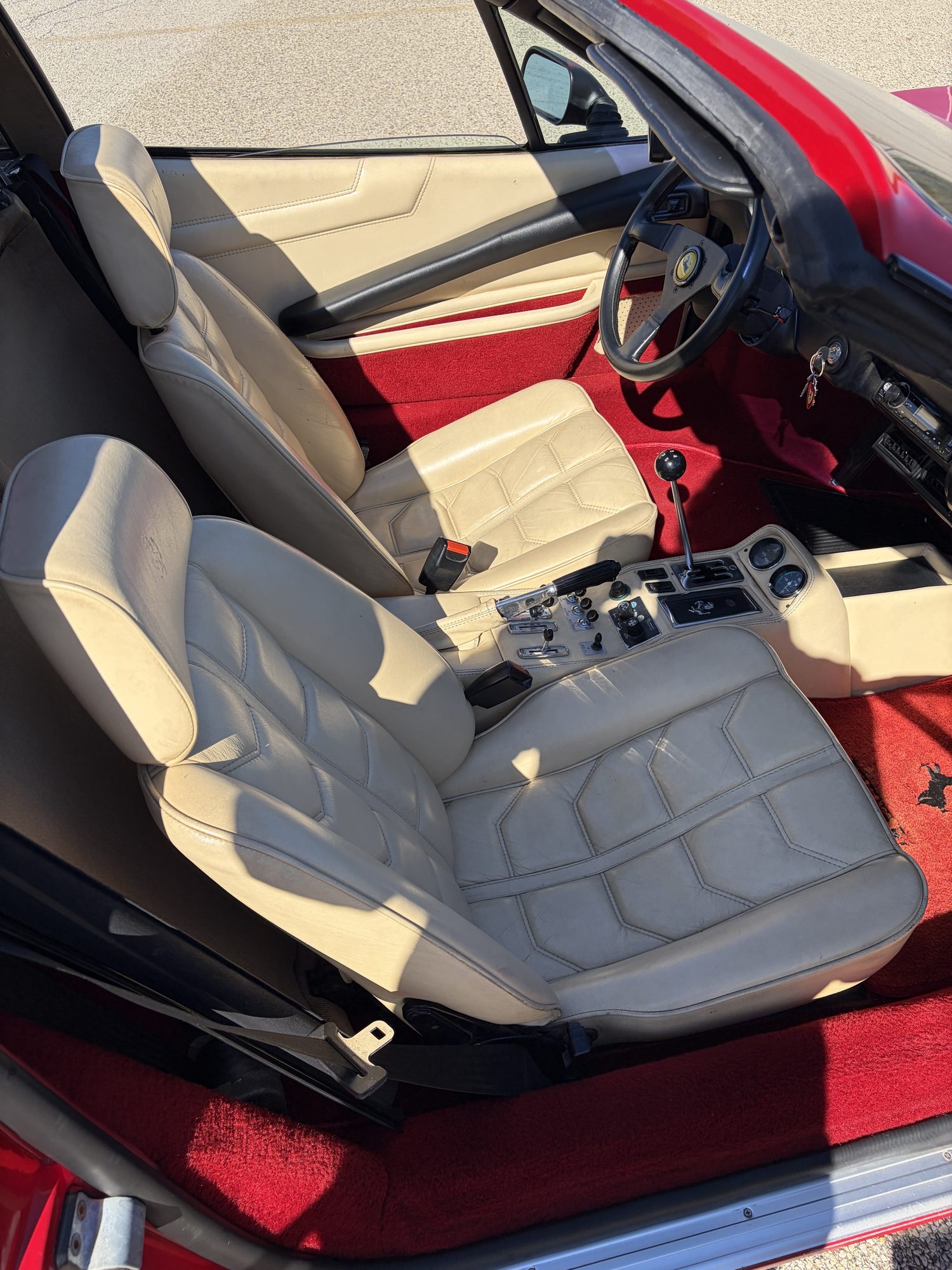 Passenger seat · dash
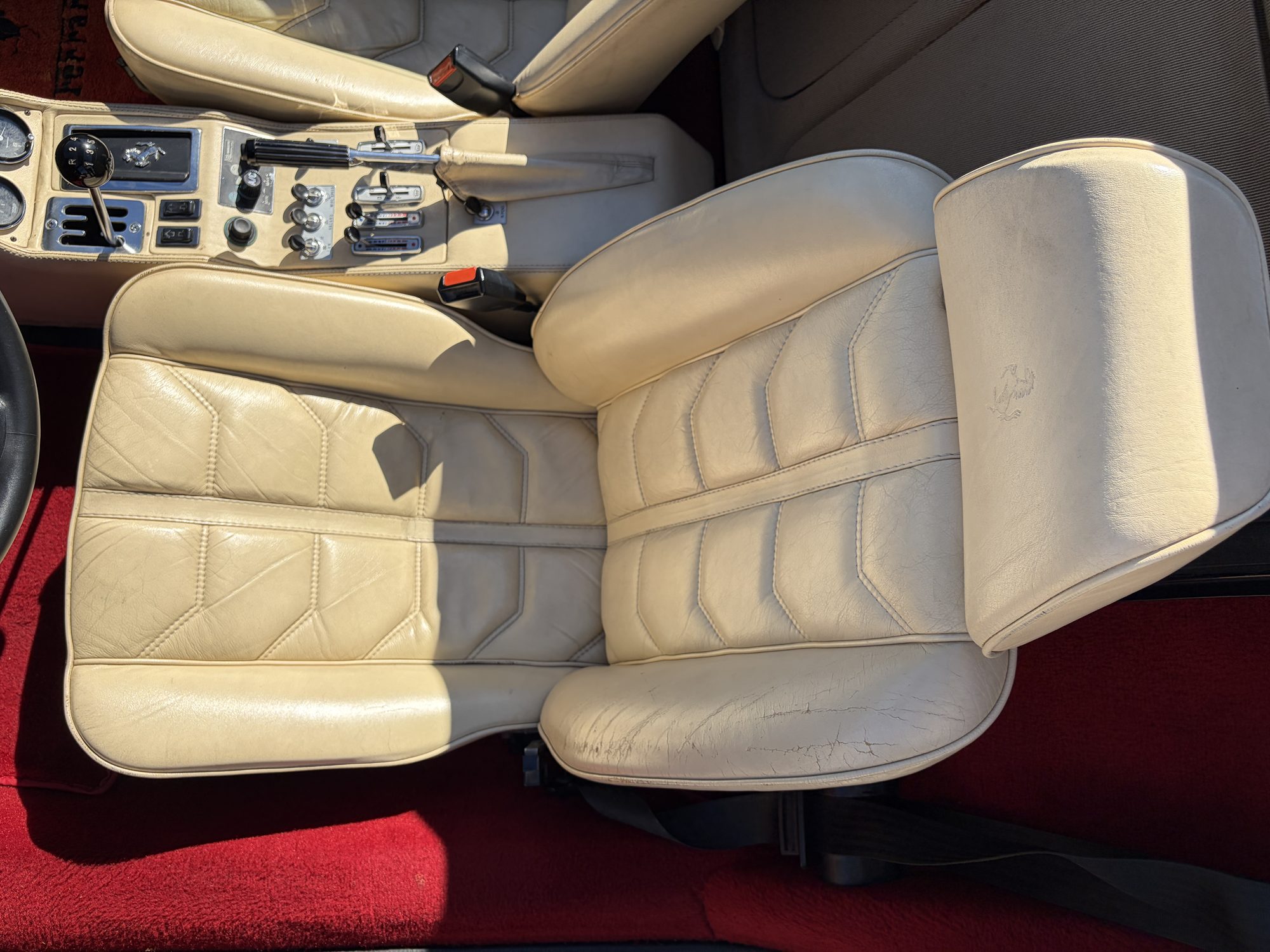 Driver seat
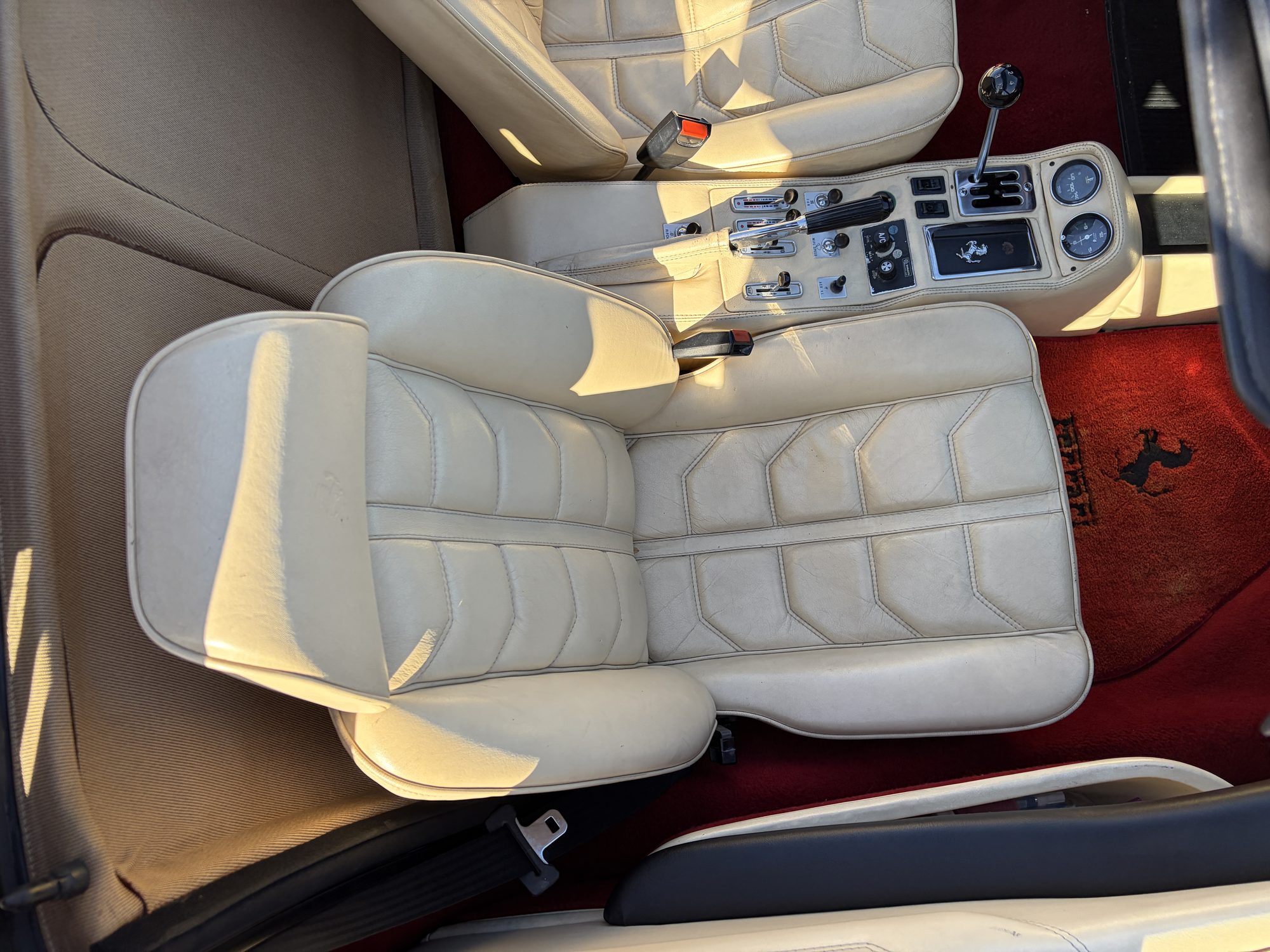 Passenger seat · horse floor mat
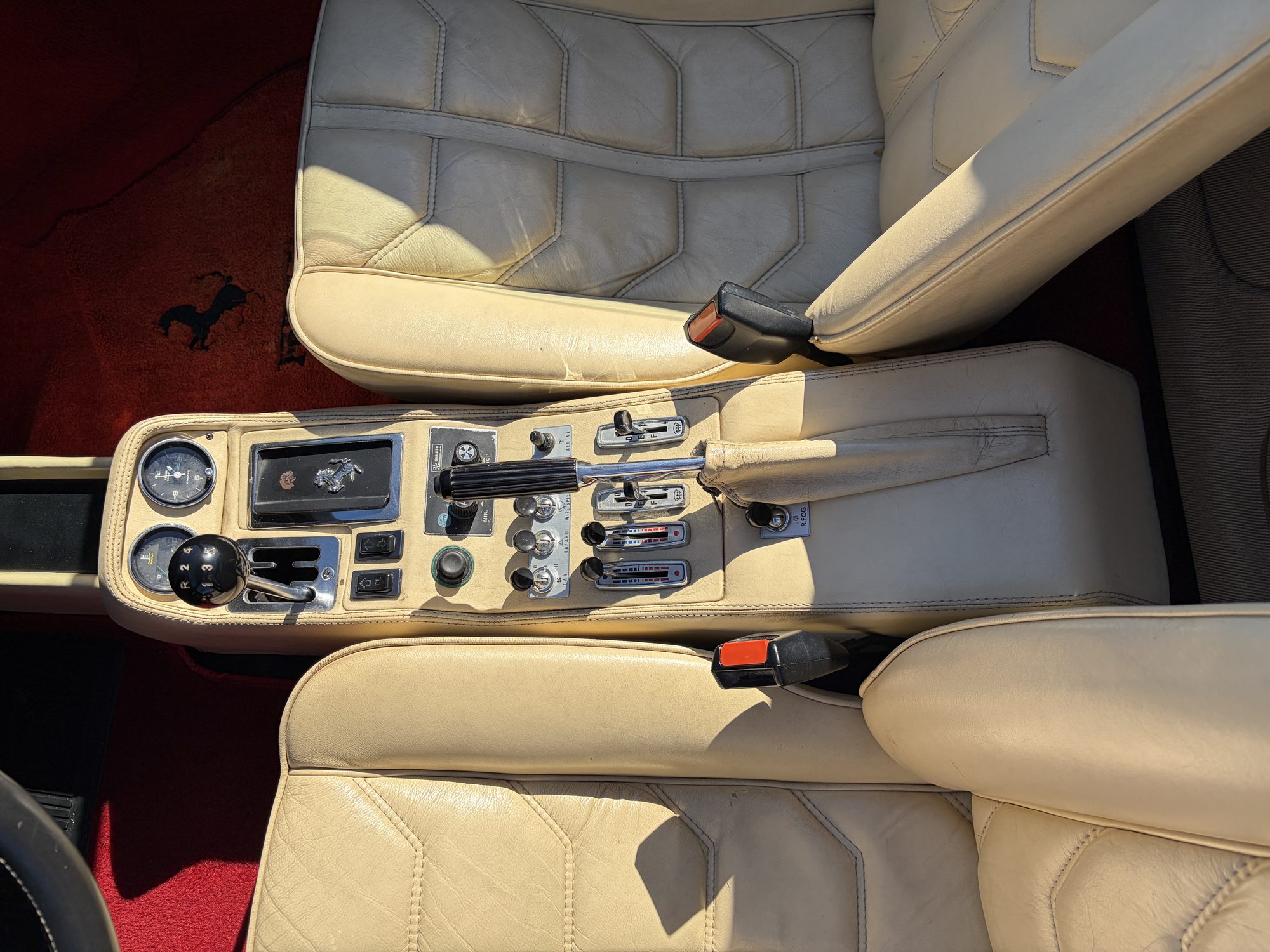 Console · gated shifter
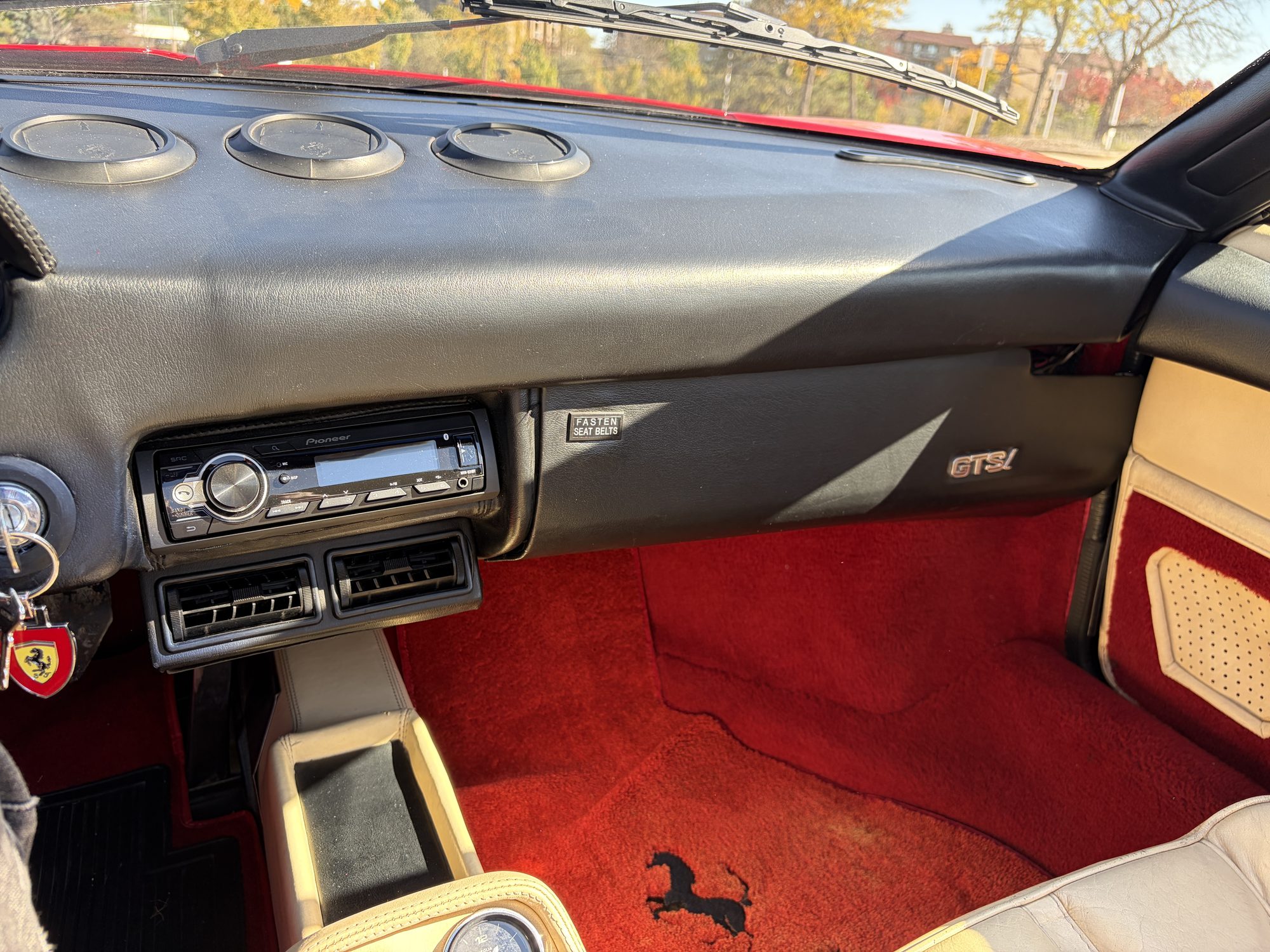 Center stack · passenger footwell
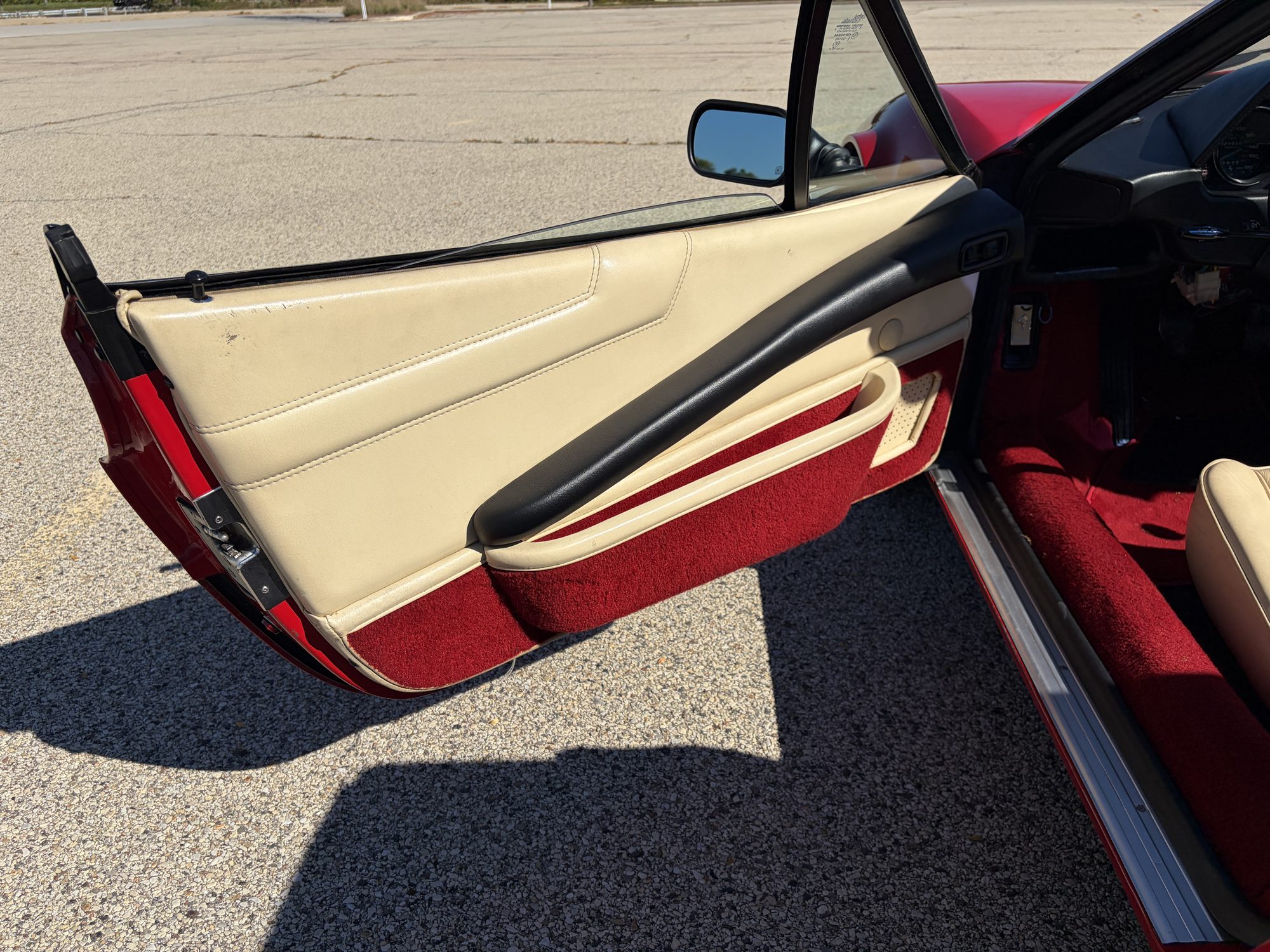 Door card · driver
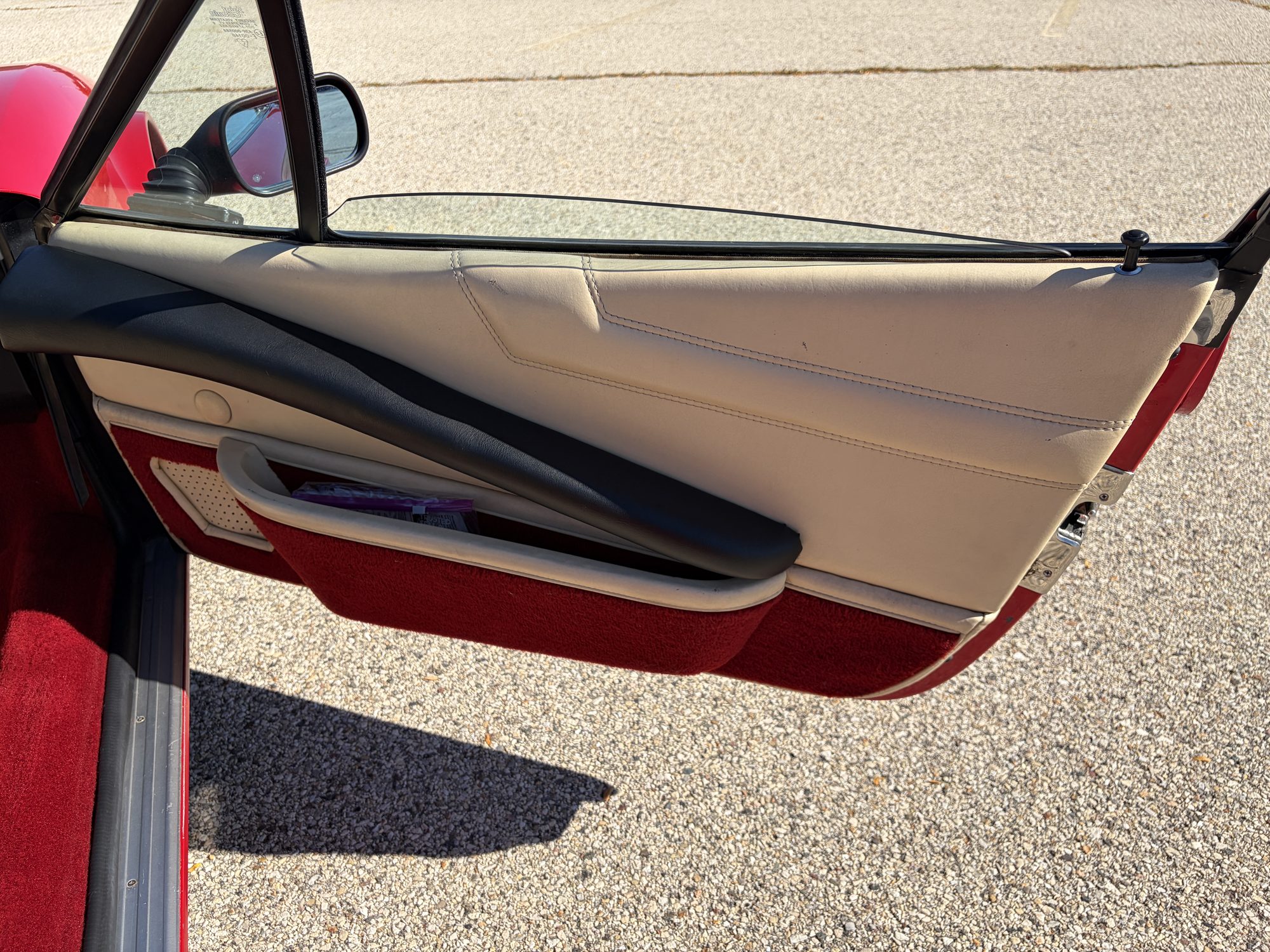 Door card · passenger
Engine · Tipo F105A 32-valve V8
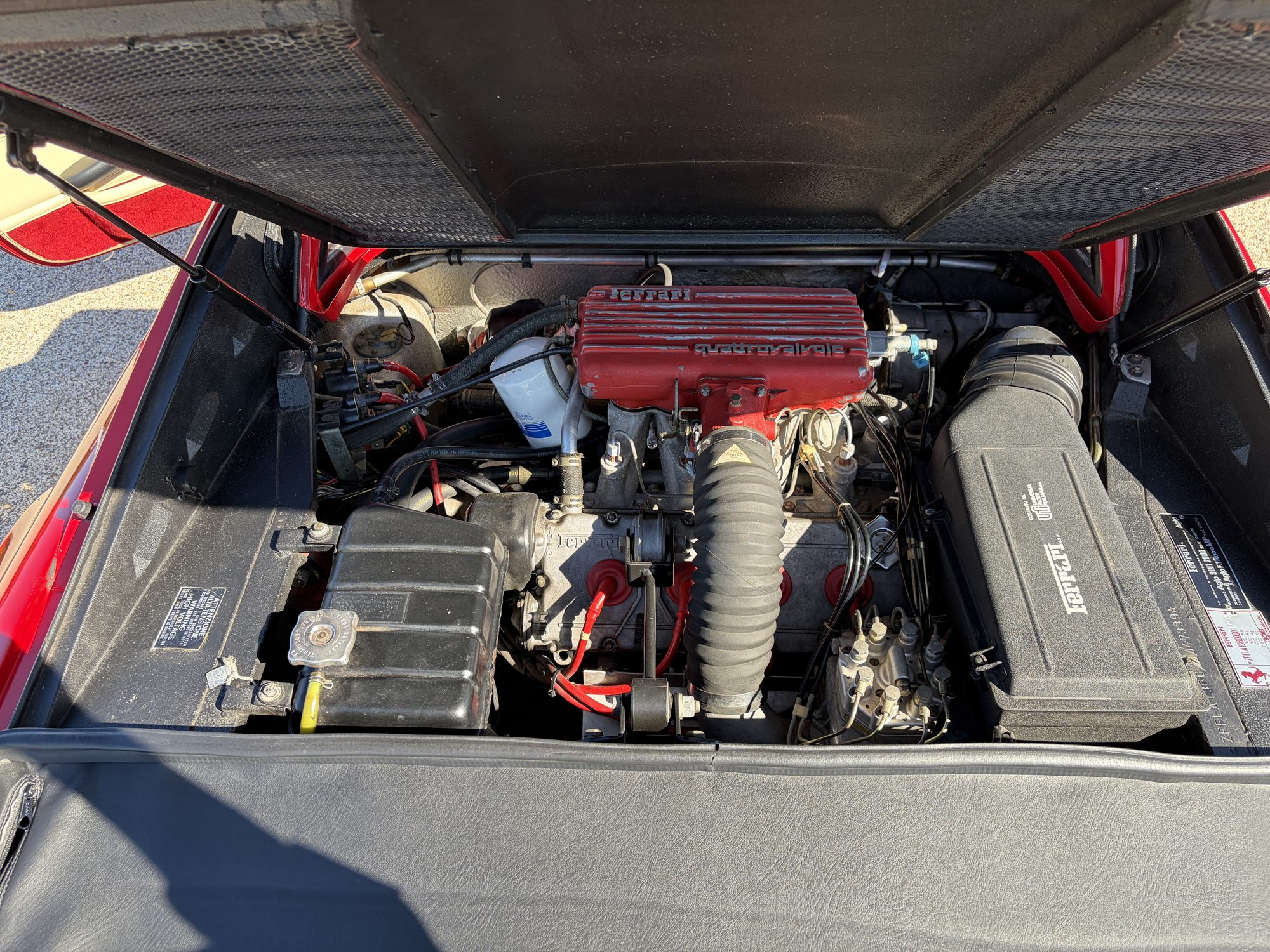 Engine bay · overview
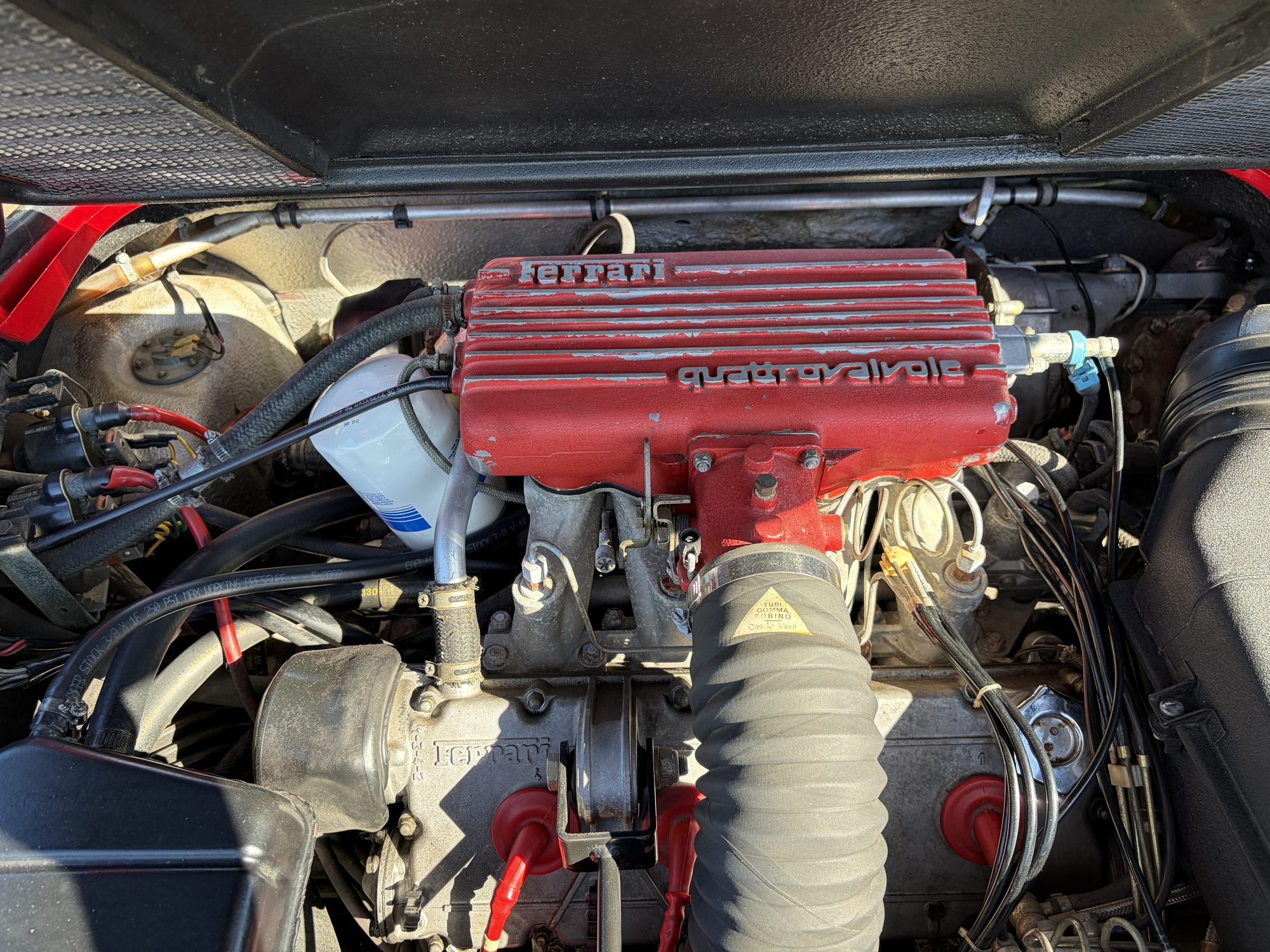 Plenum · quattrovalvole script
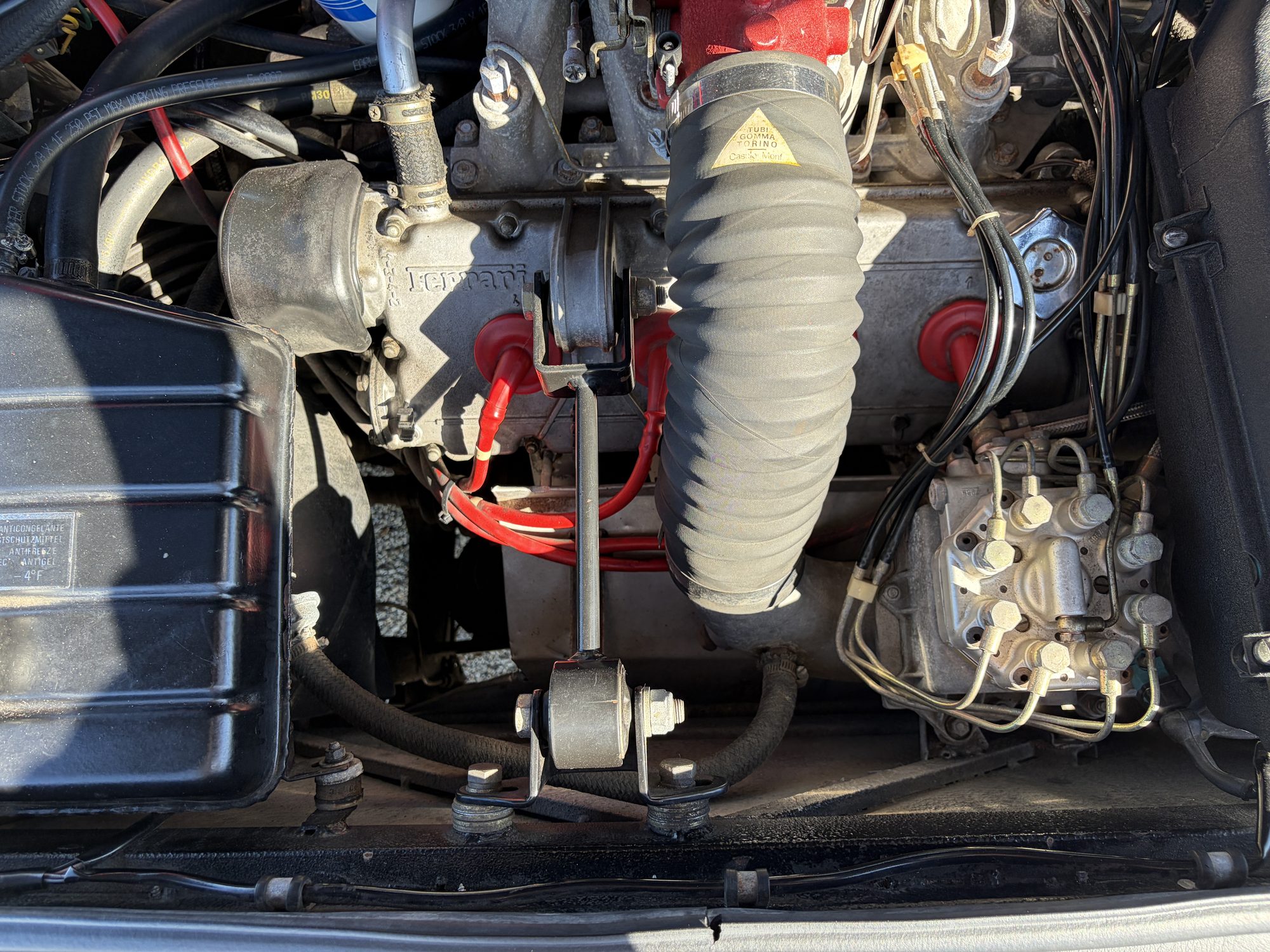 K-Jetronic · intake detail
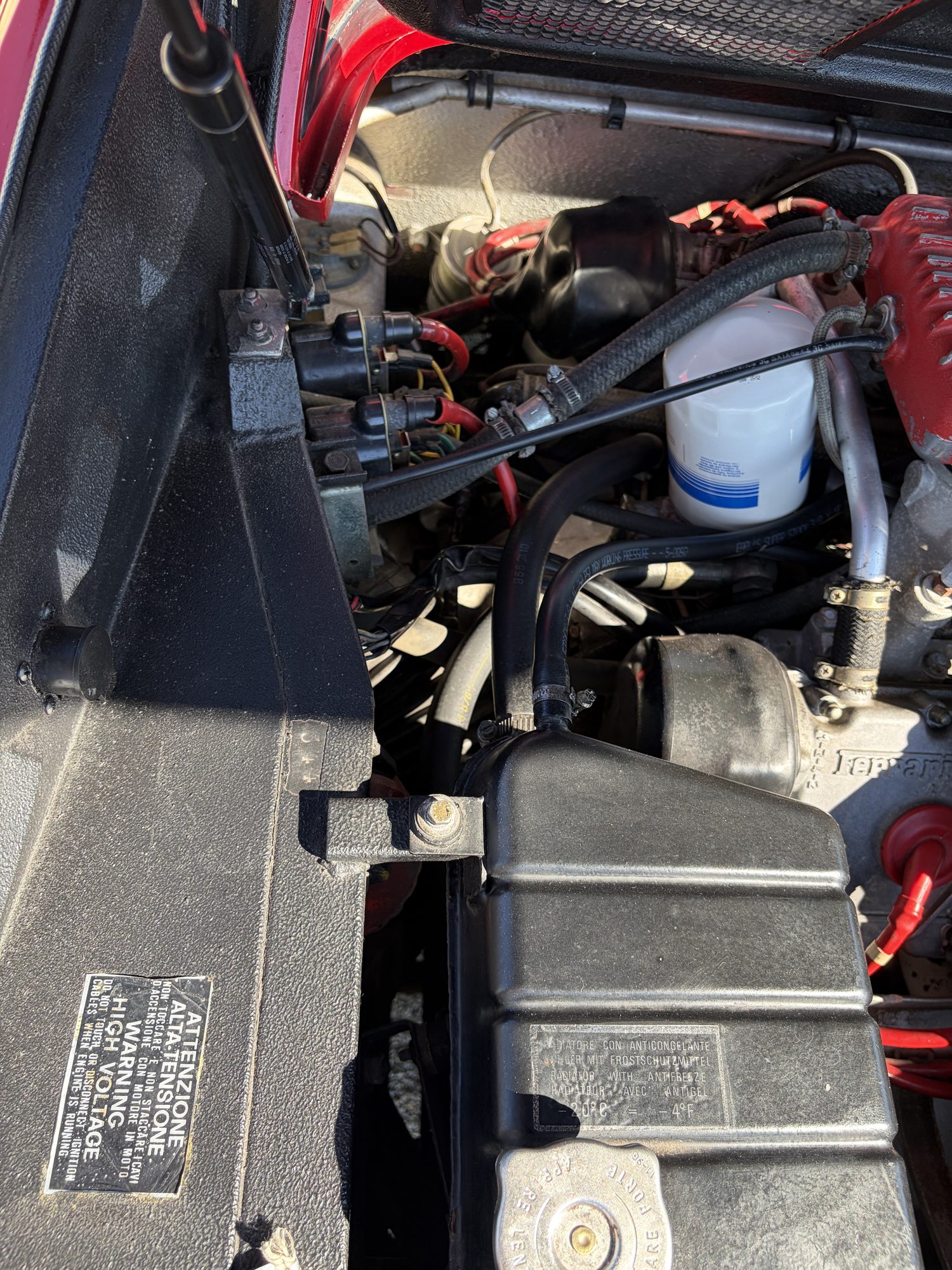 Engine bay · left side
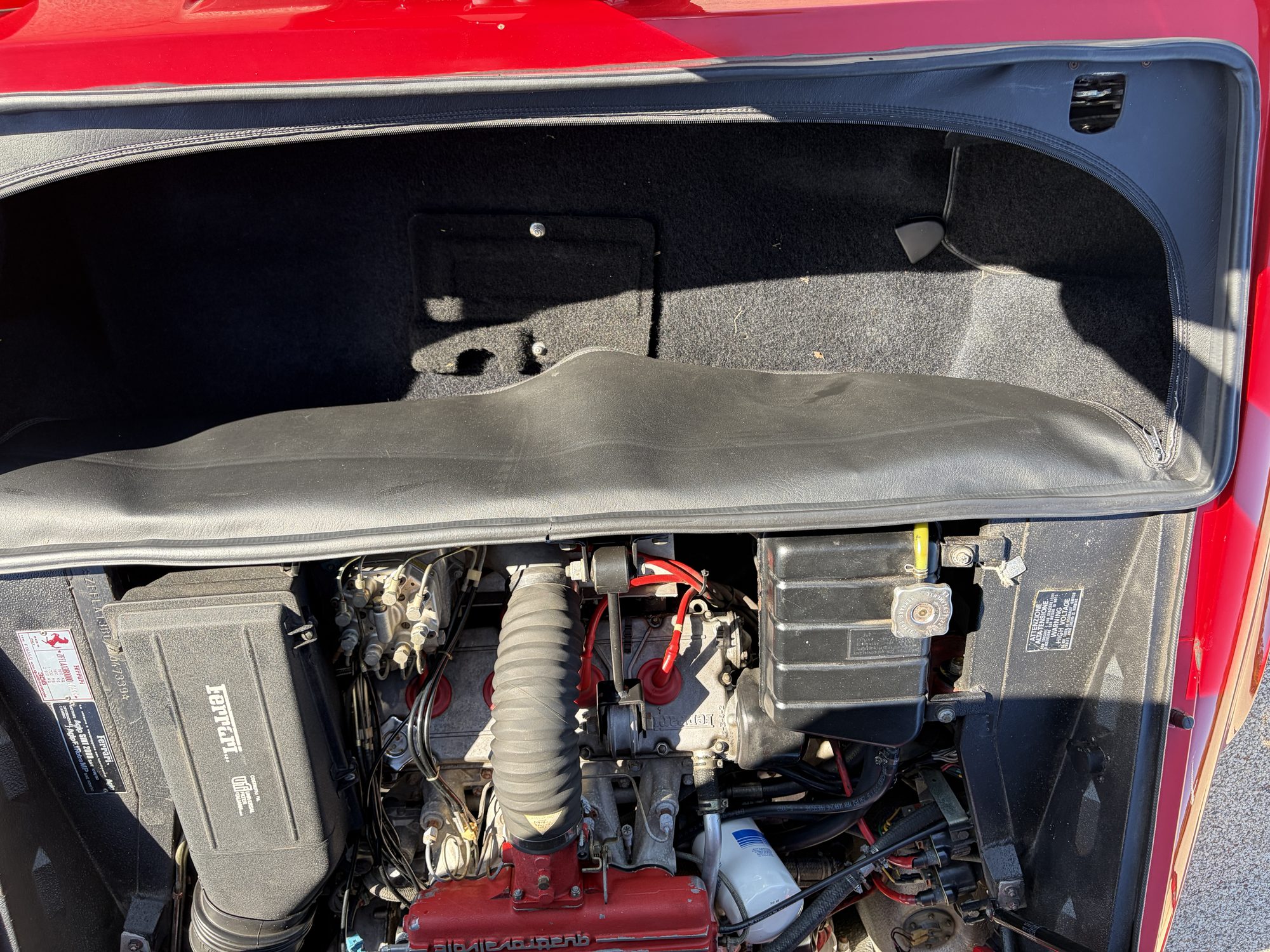 Engine bay · from rear
Front compartment · spare wheel
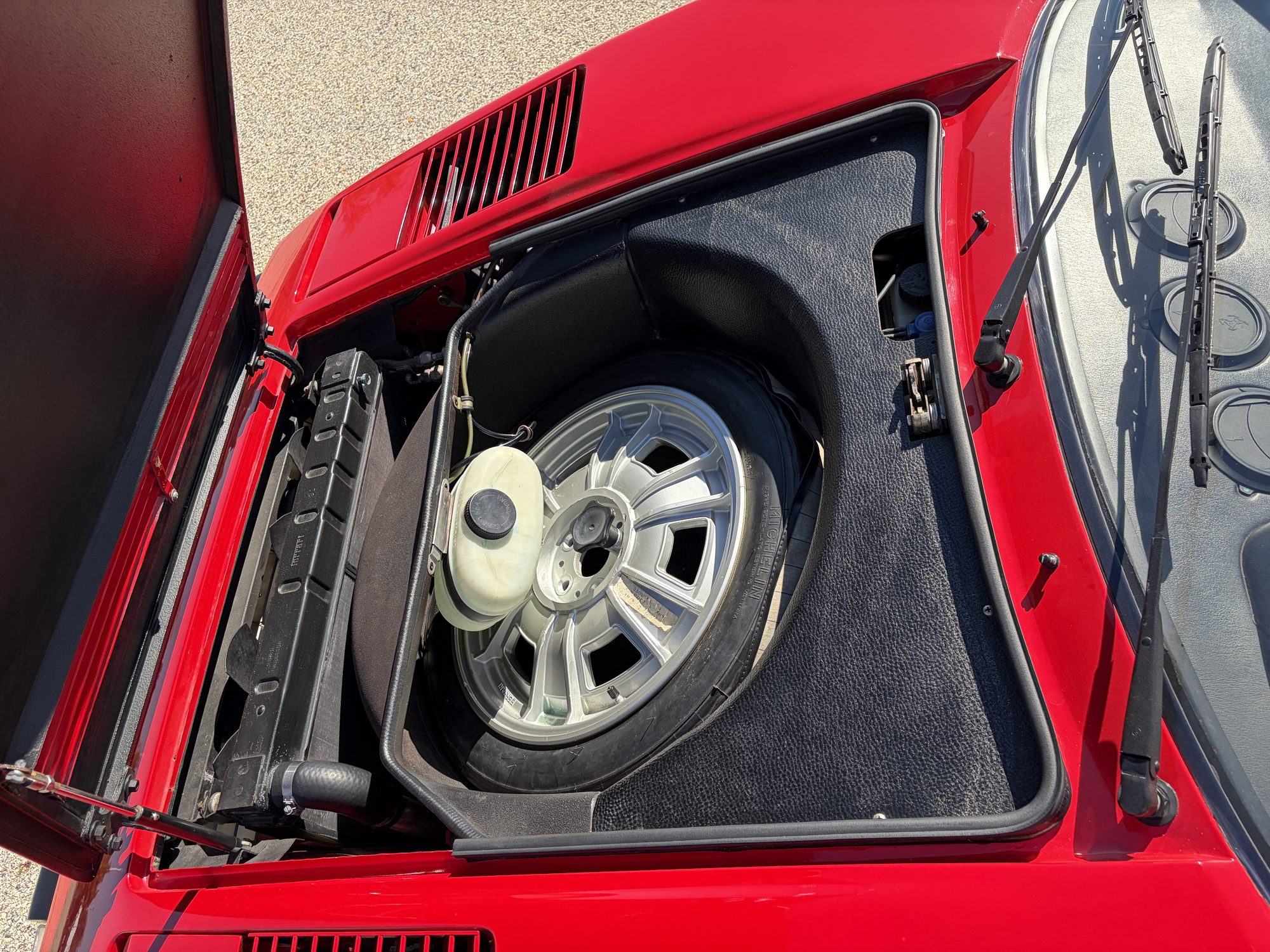 Front compartment · left
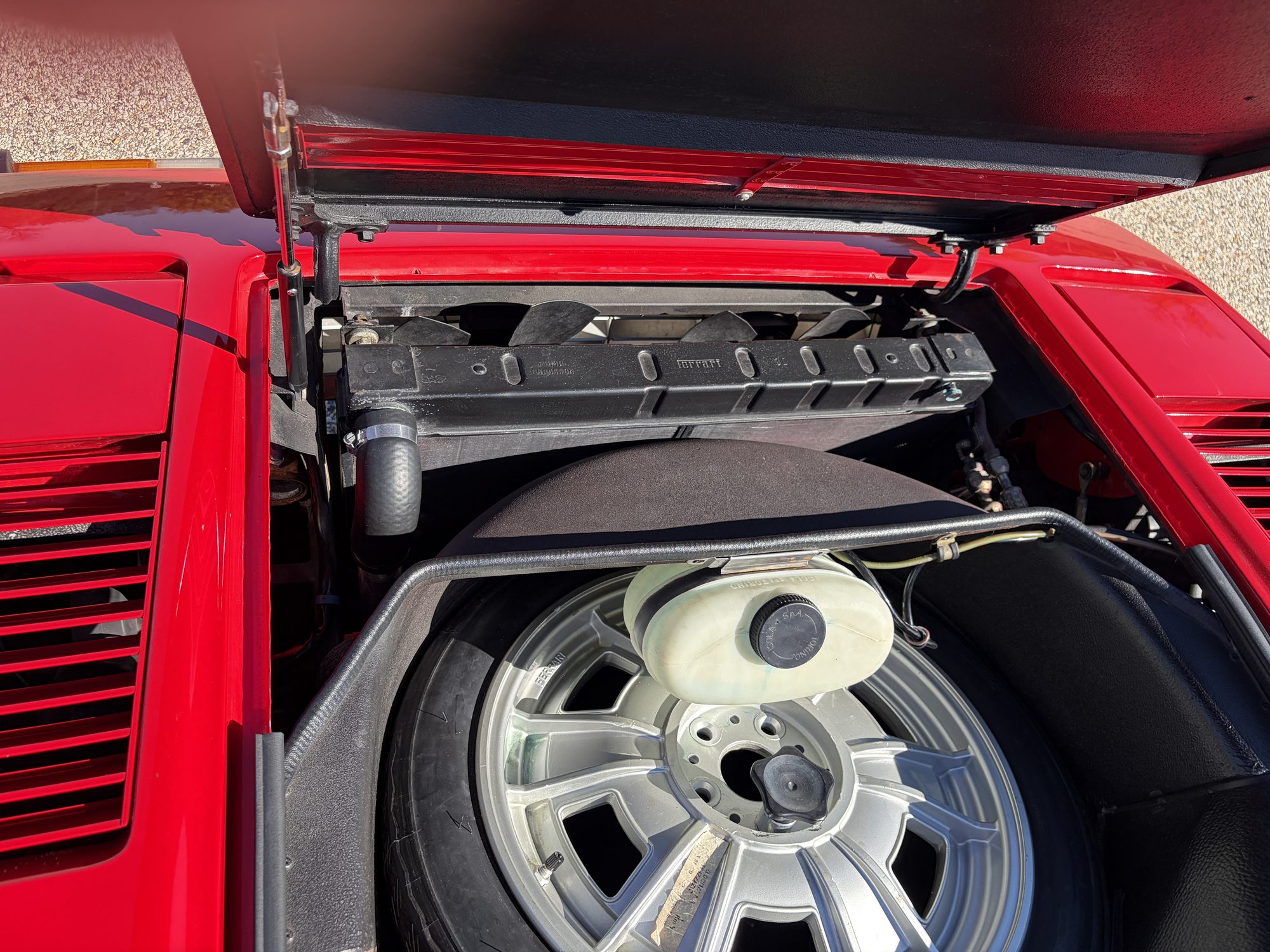 Spare wheel
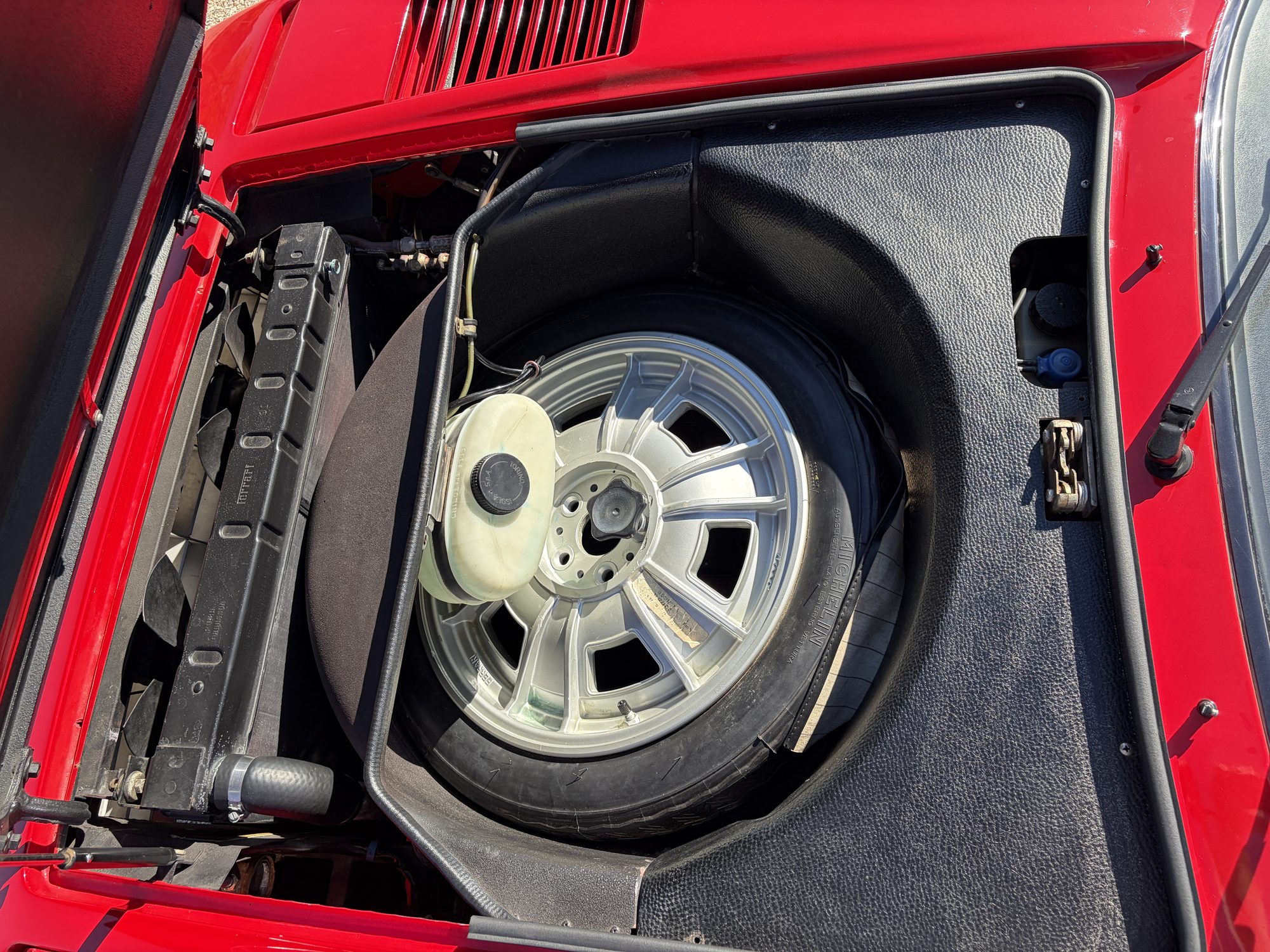 Front compartment · right
Factory Specifications · Euro-spec
Engineering & Design · What Makes This Ferrari
The 308 QV was Ferrari's answer to a decade of emissions regulations that had steadily strangled the transverse V8. By adding a second intake and exhaust valve per cylinder — the meaning of quattrovalvole — Maranello restored the character of the original carburetted 308 while retaining Bosch mechanical fuel injection. The result was Ferrari's most reliable and driveable two-seat V8 of the era.
32 valves, flat-top pistons, Nikasil liners
The QV's defining feature is a redesigned aluminum-alloy DOHC head with four valves per cylinder — two intake, two exhaust — arranged at a narrower included angle for a more compact, higher-swirl combustion chamber. Flat-top forged pistons raise compression from the 8.8:1 of the injected two-valve car to 9.2:1. The block's cast-iron liners were replaced with Nikasil-plated aluminum, cutting reciprocating mass and improving thermal transfer. The intake plenum was refinished in the now-iconic red crackle paint with cast Ferrari Quattrovalvole script — the fastest way to identify a QV under the deck lid.
Bosch K-Jetronic, Marelli Digiplex twin ignition
Fuel metering is handled by Bosch K-Jetronic, a continuous-flow mechanical injection system that measures inlet airflow with a hinged plate and doses fuel through mechanical injectors held open by fuel-rail pressure. There is no ECU governing fueling — only a warm-up regulator, a cold-start valve, and a mixture-adjustment screw. Ignition is a Magneti Marelli MED 803A Digiplex electronic system with one coil, one distributor, and one ignition module per cylinder bank — effectively two four-cylinder ignition systems working in parallel. The setup is famously robust: many QV owners report original K-Jetronic and Digiplex components still functioning 40+ years on with only regular sensor and hose replacement.
Engine over gearbox, all in unit
The V8 sits transversely behind the cockpit in unit with a five-speed all-synchromesh manual transaxle mounted below and behind the sump. Power feeds down through a single-plate dry clutch and a helical primary gear to the 5-speed cluster, then out through a ZF-supplied limited-slip differential. Because the transaxle lives beneath the engine, the whole powertrain drops into the chassis as one assembly — the same architecture Ferrari had used since the 1973 Dino 308 GT4 and would carry through the 328, 348, and F355.
Tubular steel, unequal-length wishbones all round
The QV rides on a tubular-steel spaceframe (factory reference F 105 GS 100 for Euro GTS), a design carried over from the injected 308 and originally derived from the short-wheelbase Dino 246. Suspension is fully independent at all four corners: unequal-length upper and lower wishbones, coil springs over telescopic hydraulic dampers, and front and rear anti-roll bars. Steering is unassisted rack-and-pinion, geared at roughly 3.3 turns lock-to-lock — light at speed, heavy at parking pace, and famously communicative. Wheelbase is a short 2,340 mm / 92.1 in; tracks are equal front and rear at 1,460 mm.
ATE ventilated discs, four corners
Braking is by ventilated ATE discs at all four corners with hydraulically operated calipers shared with contemporary Porsche 911 and 914/6 (front and rear respectively). 1984 was the year Ferrari moved from 20 mm to 24 mm rotor thickness, roughly 272 mm front and 277 mm rear, in step with the QV's slightly higher weight and revised gearing. There is no ABS, no vacuum brake booster augmentation beyond a small servo, and no electronic aids of any kind — a period-correct setup that rewards deliberate, unhurried pedal work.
Pininfarina design, Scaglietti assembly, targa roof
The 308 body was penned by Leonardo Fioravanti at Pininfarina — the same designer responsible for the 365 Daytona, 308 GTB, 512 Berlinetta Boxer, and F40. Panels are pressed steel with an aluminum front lid; from 1984 Ferrari galvanized the steel for the first time on a road car, greatly improving corrosion resistance. Assembly was by Carrozzeria Scaglietti in Modena, Ferrari's long-time coachbuilder. The GTS's defining feature is a removable body-color targa panel that stores behind the seats — the first Ferrari to use this Porsche-style layout, which drove GTS sales past GTB by roughly 4:1 over the model's life.
Euro-Spec vs US-Spec · The Delta That Drives Value
The regulatory divergence between Europe and the United States in the early 1980s produced two mechanically and visually distinct cars sold under one name. The Euro-spec car is lighter, more powerful, breathes freely, and wears the original Pininfarina bodywork without federal impact bumpers. Chassis 47339 is a European-market car (VIN prefix ZFFLA), and the delta below is the material reason Euro cars generally trade at parity or a premium to US cars in the collector market.
| Attribute | Euro-spec (ZFFLA prefix) | US-spec (ZFFUA prefix) |
|---|---|---|
| Engine code | Tipo F 105 AB 000 | Tipo F 105 A 040 |
| Compression ratio | 9.2:1 | 8.6:1 |
| Peak power (DIN) | 240 hp @ 7,000 rpm | 230 hp @ 6,800 rpm |
| Peak torque | 192 lb-ft @ 5,000 rpm | 188 lb-ft @ 5,500 rpm |
| 0–60 mph (mfr) | 6.1 sec | 6.7 sec |
| Top speed (mfr) | 158 mph / 255 km/h | ~154 mph / 248 km/h |
| Emissions equipment | None — no catalyst, no air-injection pump, single distributor per bank | Twin dual-bed catalytic converters, air-injection pump, EGR, revised Digiplex mapping, unleaded fuel required |
| Front bumper | Slim body-following bumper, deeper front air dam | Federal 5-mph impact bumper on shock absorbers — protrudes ~3 in further, additional "fangs" |
| Rear bumper | Slim body-following bumper | Impact bumper on spacer, reinforced rear bulkhead |
| Side markers | Small circular amber front repeaters, no rear side lights | Large rectangular amber front / red rear DOT side markers |
| Headlights | H1 / H4 replaceable-bulb pop-ups with flash-to-pass through grille | Sealed-beam pop-ups mandated by FMVSS |
| Exhaust | Twin polished tips exiting through rear valance | Four black-shrouded outlets behind catalytic converter cover |
| Engine deck vents | Two separate polished vent strips | Single U-shaped vent to accommodate catalyst heat |
| Silencer / cam cover finish | Polished aluminum | Satin black cover over catalyst |
| Speedometer | km/h primary, unrestricted scale to 300 km/h | mph primary; some 1980–81 US cars have red-arc marking between 80 and 100 mph per federal 55-mph era |
| Fuel tanks | Twin tanks, 74 L combined (19.6 US gal) | Twin tanks, 70 L combined (18.5 US gal) |
| Instrument warnings | No "Fasten Seat Belt" light | "Fasten Seat Belt" and additional emissions/warning lights |
| Curb weight | ≈ 2,956 lb (1,341 kg) | ≈ 3,120 lb (1,415 kg) — roughly 110–260 lb heavier depending on year |
| Ferraris built (all markets, GTS) | 3,042 GTS + 748 GTB — chassis range 41701–59265 (GTS) | |
Why the delta matters for 47339
- Original bodywork. Federalizing a Euro car after import requires either living with the mismatch or bolting on US bumpers and markers — both compromise resale. 47339 was federalized with reversible-only modifications, preserving the Euro visual signature.
- Free-breathing V8. Removing the catalyst, air pump, and EGR plumbing lifts peak power ~10 hp and dramatically opens the top-end. Owners who have driven both back-to-back consistently describe the Euro car as "the version Ferrari intended."
- ~110 lb lighter. The weight delta shows in throttle response, brake feel, and steering effort. On the 2,956-lb Euro car, weight-to-power is 12.3 lb/hp vs 13.6 lb/hp on the US car.
The Ferrari Transverse V8 Lineage · 1973 – 1994
The 308 GTS QV sits at the mid-point of Ferrari's 21-year transverse-V8 arc. Every car in this lineage shares the same fundamental architecture — small-displacement 90° V8, four camshafts driven by rubber toothed belts, transverse mid-mount with the gearbox in unit below the sump — refined generation over generation. The QV era is widely regarded as the analog high-water mark of the family.
Driving Character & Period Performance Data
Verified test data from the period and later retrospectives. The QV is neither the fastest nor the most exotic Ferrari — but it is the model most owners describe as the one they drive the most.
What the QV actually feels like
The 308 QV is the smallest, lightest V8 Ferrari of the modern era — a car so compact that even a six-foot driver can see all four corners from the seat. The steering, unassisted at any speed, loads up progressively; the brake pedal is firm and requires deliberate pressure; and the open-gate 5-speed forces every shift through an audible click of aluminum on aluminum. Below 4,000 rpm the exhaust note is unremarkable, almost small-car. Above 5,500 rpm the flat-plane V8 transitions into the metallic mechanical howl that only Ferraris and racing engines produce — a sound engineered by the firing order of a 180° crankshaft, not the cylinder count. Chassis 47339's benchmark is not a spec-sheet number but that transition: the moment a QV comes on cam and becomes what it was designed to be.
21,020 documented mi · concours
Treat print as an outlier
+65% since baseline
Notable Recent Comps
2026 Market Momentum
Broader Ferrari market contextChassis 47339 doesn't sit in a vacuum. The analog-Ferrari market is being re-rated sharply upward in 2026, with H1 auction volume up +52% YoY and modern collectible Ferraris up +16.3% since April 2026 alone. The 308 QV inherits this tailwind as a fully analog, factory-manual mid-engine Ferrari.
- 458 market: +84% trend, median ~$290K, avg ~$335K. Friday's Watchlist
- 458 Speciale: $687,500 at Mecum Kissimmee (Jan 2026); record $1,136,500 on BaT (Jun 2026). Garage Style
- 458 Speciale Aperta: €700K–€1.175M in European sales; Quail estimate $2.2M–$2.5M. Business Insider
- 488 reversal: Depreciation stopped; Spiders now clearing $300K+. Feb 2026 dealer report
The strongest signal in the 2026 market is the widening spread between gated-manual and paddle-shift equivalents. Chassis 47339 is a factory 5-speed gated manual — the same analog architecture buyers are chasing.
- F355 6-speed manual: +142% since 2020. Manual/F1 spreads run +45% to +73%. Hagerty Gold Index Pick for 2025. Exotics Wanted
- F430 factory manual: Roughly 2× the F1 equivalent. Broad Arrow Quail estimate for a 19K-mi factory-manual F430: $300K–$400K. Jalopnik
- 599 GTB factory manual (~30 built worldwide): asking prices approaching $900K; realized sales $600K–$700K. Exotic Car Marketplace
- Ferrari's own response: 12Cilindri Manuale announced Jul 2026 at €590K ($672K), limited to 1,499 units, invitation-only. Ferrari acknowledging what the auction market already priced in. Reuters
Every 308 is factory-manual, so the QV doesn't get the F1-vs-manual split premium the way an F430 does. But the analog-Ferrari halo lifting the F355, F430, and 458 is the same tailwind supporting 308 values — and the March 2026 BaT sale at $137,000 is direct evidence it's already flowing into the 308 QV segment. Treat auction records as ceilings, not medians; the market is running hot enough that some print-to-print variance is froth, not floor.
Sources verified 11 Aug 2026. Data points reflect auction and dealer market reporting; individual results vary by condition, provenance, and originality.
Price vs Mileage · 0–30k range highlighted
Circle size ∝ log(price). Dashed vertical line marks the 21,020-mile Chassis 47339 point. Dashed horizontal line marks the $150,000 value of chassis 47339. Click any point to open the listing.
Euro vs US Premium
Aggregate: no reliable premium. Since 2024, US-market cars have led (RM Monterey 3,935-mi GTS at $162,400, BaT high-print 19k-mi GTS at $142,000). Euro cars supply both the record GTB ($182,000, 2,548 mi) and the softest results. The most relevant 2026 Euro print for chassis 47339 is the March 2026 BaT sale at $137,000 (1984 GTS, Euro-spec, 14,292 mi, modified) — same year, same body, same spec, comparable mileage. That car had been modified; an unmodified example with 47339’s documentation and color combination supports $150,000.
| Cohort | n | Median | Mean |
|---|---|---|---|
| Euro/Swiss/UK | 34 | $86,500 | $88,722 |
| US-spec | 30 | $82,154 | $92,233 |
| 2024–2026 Euro | 20 | $97,194 | — |
| 2024–2026 US | 11 | $112,000 | — |
Price by Mileage Band
Curve is monotonic but weak until mileage falls below ~10k. Provenance and originality — not spec — drive the extremes.
| Band | n | Median |
|---|---|---|
| < 10k mi | 3 | $162,400 |
| 10–20k | 10 | $120,684 |
| 20–30k (47339 zone) | 20 | $91,750 |
| 30–40k | 22 | $97,500 |
| 40–60k | 32 | $74,500 |
| 60k+ | 14 | $67,250 |
Monthly Market Trend · Jan 2020 – Jul 2026
102 confirmed sold results (BaT + RM Sotheby's). Bonhams contributes descriptive rows only — the house does not publish hammer prices on closed lot pages. Volume is thin: 30 of 79 months have zero confirmed sales. Read the rolling median as the trend, not any single monthly print. This chart refreshes monthly.
Chassis 47339 · Delta Tracker
Why $150,000
- Closest sale. The March 2026 Bring a Trailer sale at $137,000 was a modified 1984 Euro-spec GTS QV. Chassis 47339 is unmodified, which carries the premium to $150,000.
- Factory Euro-spec. Original slim-bumper Pininfarina bodywork and the lighter, more powerful, catalyst-free V8 — the version collectors seek.
- Rare color combination. Rosso Corsa (Glasurit FER 300 factory paint label) over pale Crema hides with deep-red carpet, 21,020 documented miles, gated 5-speed manual.
- Room above. Lower-mileage QVs have sold for $162,400 (US GTS, RM Monterey 2024) and $182,000 (Euro GTB, 2026). The $302,500 Mecum record is an outlier, not a market level.
Comparables Table
| Date | House | Body | Yr | Spec | Mileage | Condition | Sale Price | Listing |
|---|